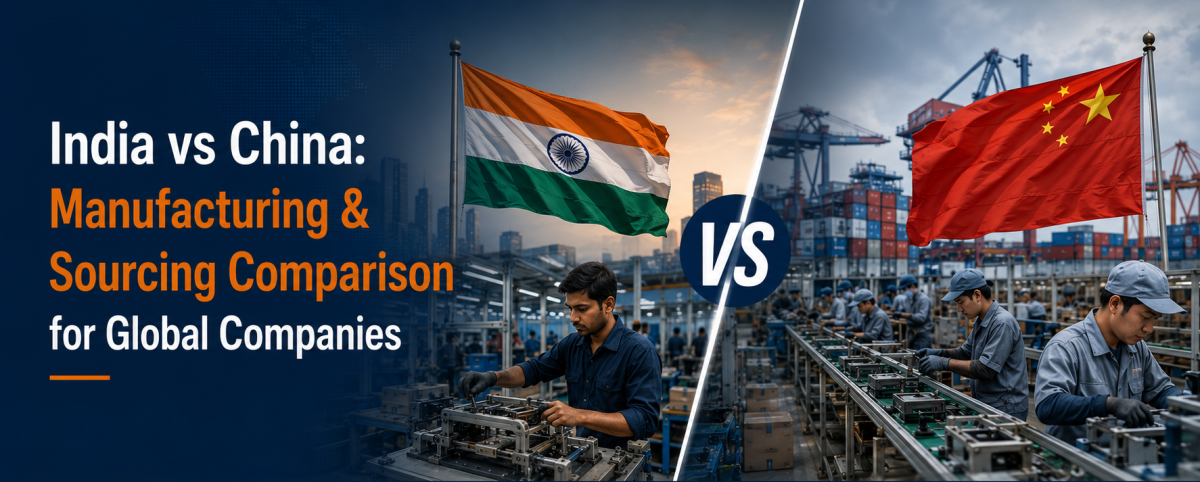
For more than three decades, China has been the world’s manufacturing powerhouse. Its extensive industrial ecosystem, large-scale production capabilities, advanced infrastructure, and export-oriented economy transformed the country into the preferred sourcing destination for global companies.
However, the global manufacturing landscape is changing.
Rising labor costs in China, geopolitical tensions, supply chain disruptions, trade restrictions, and increasing demand for supply chain diversification have prompted multinational companies to explore alternative manufacturing destinations.
As a result, India has emerged as one of the most promising sourcing and manufacturing alternatives to China.
Today, many global businesses are adopting a “China Plus One” strategy, maintaining operations in China while expanding sourcing and manufacturing activities into countries such as India, Vietnam, Mexico, and Indonesia.
Among these alternatives, India stands out because of its large workforce, expanding manufacturing base, government incentives, growing domestic market, and long-term economic potential.
This article compares India and China across key manufacturing and sourcing factors to help global companies make informed supply chain decisions.
Why Global Companies Are Looking for Sourcing Alternatives to China
The shift away from exclusive dependence on China is being driven by multiple factors.
Average manufacturing wages in China have increased significantly over the past decade, reducing some of the cost advantages that originally attracted global manufacturers.
At the same time, trade tensions between major economies, particularly the United States and China, have increased uncertainty for international supply chains.
The COVID-19 pandemic further exposed the risks of concentrating production in a single country, leading many businesses to rethink sourcing strategies and improve supply chain resilience.
As a result, companies across industries including electronics, machinery, consumer products, automotive components, textiles, healthcare, and industrial goods are actively evaluating alternative sourcing destinations.
India vs China Manufacturing: Labor Costs and Workforce Availability
Labor costs remain one of the most important considerations for manufacturers.
China’s manufacturing workforce has become increasingly skilled, but labor costs have risen substantially as the country’s economy has matured.
India, by comparison, continues to offer a significant labor cost advantage in many manufacturing sectors.
India also benefits from one of the world’s youngest populations, with a median age of approximately 29 years compared to China’s aging workforce.
Every year, millions of young workers enter India’s labor market, creating a large talent pool for manufacturing industries.
For labor-intensive industries such as textiles, apparel, footwear, furniture, consumer goods, and assembly operations, India offers attractive cost advantages.
Advantage: India
India vs China Manufacturing Infrastructure Comparison
Infrastructure has traditionally been one of China’s strongest competitive advantages.
China possesses highly developed ports, highways, industrial parks, rail networks, and logistics systems that support large-scale manufacturing and exports.
India has historically lagged behind in this area, but significant investments are rapidly narrowing the gap.
Government initiatives such as PM Gati Shakti, Bharatmala, Dedicated Freight Corridors, Industrial Corridors, Sagarmala, and National Logistics Policy are transforming India’s infrastructure landscape.
India is investing billions of dollars annually in roads, ports, airports, logistics hubs, and industrial parks to improve manufacturing competitiveness.
While China still maintains an advantage in infrastructure maturity, India’s progress is creating increasingly attractive conditions for global manufacturers.
Advantage: China (currently), India (rapidly improving)
Supply Chain Ecosystem: India vs China Manufacturing Capabilities
China’s biggest strength remains its manufacturing ecosystem.
In many industries, suppliers, component manufacturers, assembly facilities, logistics providers, and exporters operate within tightly integrated industrial clusters.
This creates significant efficiency advantages.
India’s manufacturing ecosystem is expanding rapidly but remains less integrated than China’s in certain sectors.
However, India has developed strong capabilities in:
- Pharmaceuticals
- Automotive components
- Chemicals
- Engineering goods
- Textiles and apparel
- Electronics assembly
- Renewable energy equipment
- Industrial machinery
As more global companies establish operations in India, supplier networks continue to strengthen.
Advantage: China
Government Incentives and Manufacturing Support
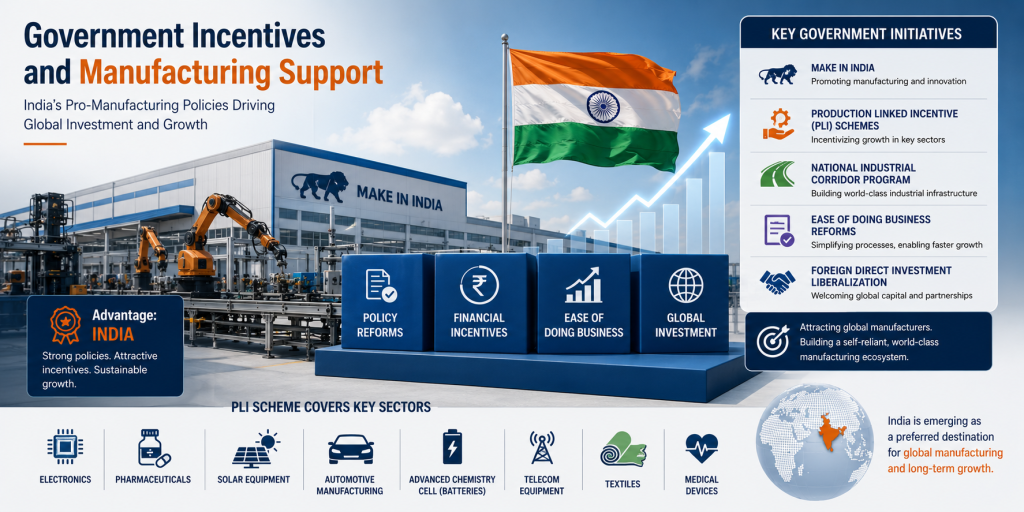
India has introduced aggressive policies to attract global manufacturers.
Programs such as:
- Make in India
- Production Linked Incentive (PLI) Schemes
- National Industrial Corridor Program
- Ease of Doing Business Reforms
- Foreign Direct Investment Liberalization
have significantly improved India’s attractiveness for international investors.
The Production Linked Incentive (PLI) scheme alone covers multiple sectors including electronics, pharmaceuticals, solar equipment, automotive manufacturing, batteries, telecom equipment, textiles, and medical devices.
These incentives are encouraging both foreign investment and domestic manufacturing expansion.
China continues to provide support for manufacturing industries, but India’s incentive programs are increasingly attracting global attention.
Advantage: India
Domestic Market Potential: India vs China
For many manufacturers, production decisions are increasingly linked to local market opportunities.
China remains one of the world’s largest consumer markets, but economic growth has moderated in recent years.
India, on the other hand, is expected to remain one of the fastest-growing major economies globally.
With a population exceeding 1.4 billion and a rapidly expanding middle class, India offers manufacturers the dual advantage of serving both export markets and domestic consumers.
Many international companies now view India not only as a sourcing destination but also as a strategic long-term growth market.
Advantage: India (future growth potential)
Geopolitical Risk and Supply Chain Resilience
Geopolitical risk has become a major factor in sourcing decisions.
Companies increasingly seek diversified supply chains to reduce exposure to trade disputes, tariffs, sanctions, political tensions, and unexpected disruptions.
India is generally viewed as a stable and strategically important partner for many global economies.
The country’s strong diplomatic relationships and growing integration with international supply chains make it an attractive location for supply chain diversification.
For companies implementing a China Plus One strategy, India often becomes a preferred secondary manufacturing base.
Advantage: India
Ease of Doing Business: India vs China
Both countries have undertaken significant reforms to improve business environments.
China benefits from decades of manufacturing experience and highly efficient industrial zones.
India has made substantial progress in simplifying regulations, digitizing government services, improving customs procedures, and streamlining investment processes.
Although administrative processes can still vary across Indian states, the overall business environment has improved significantly.
Many global investors now report much smoother market entry experiences compared with previous decades.
Advantage: China (current execution), India (improving rapidly)
Which Industries Should Consider India as a China Alternative?
India is particularly attractive for companies involved in:
- Textiles and apparel
- Pharmaceuticals
- Medical devices
- Engineering products
- Automotive components
- Chemicals
- Building materials
- Renewable energy equipment
- Electronics assembly
- Consumer goods
These sectors benefit from India’s labor availability, government incentives, growing supplier base, and export competitiveness.
Why Global Companies Are Adopting a China Plus One Strategy
The reality is that most multinational companies are not completely replacing China.
Instead, they are diversifying.
A China Plus One strategy allows companies to maintain access to China’s established manufacturing ecosystem while simultaneously building additional capacity in alternative locations such as India.
This approach helps:
- Reduce supply chain risk
- Improve business continuity
- Increase sourcing flexibility
- Access new markets
- Optimize manufacturing costs
For many businesses, India has become the preferred destination for implementing this strategy.
How India Market Entry Helps Global Companies Source from India
Successfully sourcing from India requires more than identifying suppliers online.
Finding reliable manufacturers, conducting due diligence, assessing production capabilities, managing supplier relationships, and understanding local business practices are critical to long-term success.
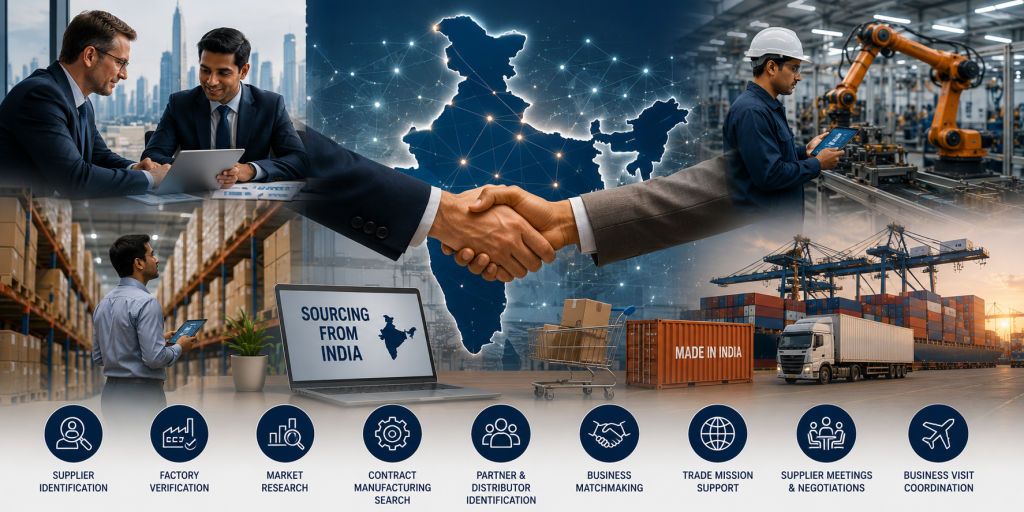
At India Market Entry, we help international companies identify sourcing opportunities and establish reliable supplier networks across India.
Our services include:
- Supplier identification
- Factory verification
- Market research
- Contract manufacturing search
- Partner and distributor identification
- Business matchmaking
- Trade mission support
- Supplier meetings and negotiations
- Business visit coordination
Whether you are exploring India as a sourcing destination or implementing a China Plus One strategy, our team helps you navigate the market and connect with trusted manufacturing partners.
Final Thoughts
China remains one of the world’s most important manufacturing economies, with unmatched industrial depth and mature supply chains.
However, the global sourcing landscape is evolving.
India’s competitive labor costs, large workforce, strong economic growth, government incentives, expanding infrastructure, and growing manufacturing ecosystem have positioned the country as one of the most attractive sourcing alternatives to China.
For global companies seeking resilience, diversification, and long-term growth opportunities, the question is no longer whether India should be part of the supply chain strategy—it is how quickly they can establish a meaningful presence in one of the world’s fastest-growing manufacturing destinations.