
Introduction: Why Global Companies Are Looking at India
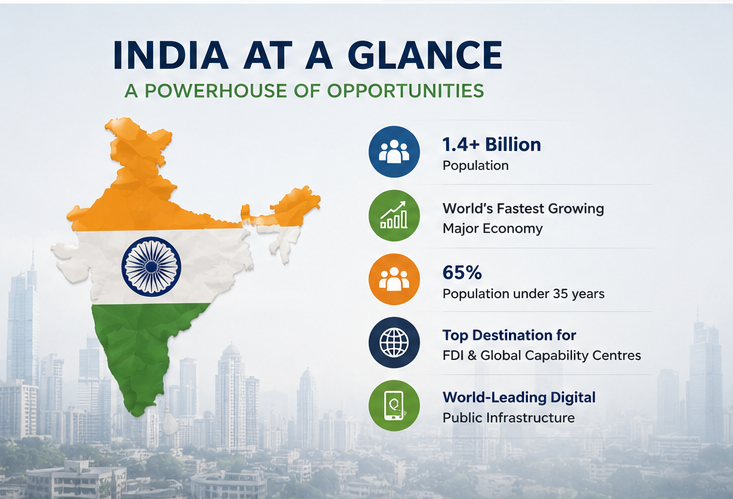
As multinational corporations reassess their global expansion strategies, India has emerged as one of the most attractive destinations for investment, manufacturing, sourcing, and business growth. With a population exceeding 1.4 billion people, a GDP of more than US$4 trillion, and a rapidly growing consumer base, India offers international businesses a unique combination of market scale, skilled talent, and economic resilience.
Whether you are a technology company, manufacturer, retailer, service provider, or investor, entering the India market presents significant opportunities for long-term growth and profitability.
India Market Entry: A Growing Economic Powerhouse
India continues to be one of the world’s fastest-growing major economies. Strong domestic consumption, infrastructure investments, manufacturing expansion, and digital transformation have positioned the country as a preferred destination for foreign businesses.
Foreign Direct Investment (FDI) inflows reached approximately US$81 billion in FY 2024-25, while cumulative FDI inflows since 2000 have crossed US$1.14 trillion. These figures demonstrate growing confidence among international investors and global corporations in India’s long-term economic prospects.
For companies considering India market entry, the country’s stable economic outlook and large domestic market provide a strong foundation for expansion.

Why Doing Business in India Makes Strategic Sense
Access to One of the World’s Largest Consumer Markets
India is home to one of the largest and youngest consumer markets globally. Rising incomes, urbanisation, and growing digital connectivity are driving demand across multiple sectors, including consumer goods, healthcare, education, financial services, retail, travel, and technology.
By 2030, India is expected to become one of the world’s leading consumption-driven economies, creating significant opportunities for international brands seeking new customers and revenue streams.
Strategic Location for Global Business
India’s geographical position provides access to key international markets across Asia, the Middle East, Africa, and Europe. Many multinational companies use India as a regional hub for operations, sourcing, manufacturing, and exports.
This strategic location allows businesses to efficiently serve both domestic and international markets from a single base.
Entering India Market Through Manufacturing and Supply Chain Expansion
Global supply chains are undergoing a major transformation, with many companies adopting a “China Plus One” strategy to diversify manufacturing operations.
India has emerged as a leading beneficiary of this shift. Through initiatives such as Make in India and Production Linked Incentive (PLI) schemes, the Government of India has encouraged investments in sectors such as:
- Electronics Manufacturing
- Semiconductors
- Automotive and EVs
- Renewable Energy
- Pharmaceuticals
- Medical Devices
- Telecom Equipment
More than 836 manufacturing projects have been approved under various PLI schemes, attracting investments exceeding US$25 billion and generating manufacturing output valued at over US$235 billion.
For foreign manufacturers, India offers a combination of competitive costs, skilled labour, government incentives, and access to a large domestic market.
India’s Skilled Workforce: A Key Advantage for International Companies
One of India’s greatest strengths is its vast talent pool. Every year, the country produces millions of graduates in engineering, information technology, finance, management, healthcare, and scientific research.
This has led many global corporations to establish:
- Global Capability Centres (GCCs)
- Research & Development Facilities
- Shared Service Centres
- Technology Development Hubs
Cities such as Bengaluru, Hyderabad, Pune, Chennai, Mumbai, and Delhi NCR have become globally recognised innovation centres, attracting investments from leading multinational companies.
Digital India: Transforming the Business Environment
India’s digital revolution has fundamentally changed the way businesses operate.
The country has built one of the world’s most advanced digital public infrastructures through initiatives such as:
- Aadhaar Digital Identity
- Unified Payments Interface (UPI)
- DigiLocker
- Digital India Programme
UPI alone processes billions of transactions every month, making India the world’s largest real-time digital payments market.
For international businesses, this digital ecosystem simplifies customer onboarding, payments, compliance, and business operations, enabling faster market penetration and scalability.
Setting Up Business in India: Popular Market Entry Options
Foreign companies have several options when entering India:
Wholly Owned Subsidiary
The most common structure for long-term investments, providing complete ownership and operational control.
Joint Venture
Suitable for companies seeking local expertise, established distribution networks, and market knowledge.
Liaison Office
Ideal for market research, relationship building, and exploring opportunities before making substantial investments.
Branch Office
Allows foreign companies to undertake approved business activities in India while maintaining direct control.
Distribution and Strategic Partnerships
A cost-effective approach for companies testing market potential before establishing a physical presence.
Challenges of Doing Business in India
While India offers significant opportunities, successful market entry requires careful planning.
Common challenges include:
- Regulatory compliance requirements
- Diverse regional markets
- Complex distribution networks
- Localisation of products and services
- Talent acquisition and retention
Companies that invest in market research, compliance planning, and local partnerships generally achieve better long-term results.
Foreign Investment in India: Sectors with High Growth Potential
Several sectors are attracting significant international investment:
Technology and Artificial Intelligence
India’s growing digital economy continues to create opportunities in software, AI, cloud computing, cybersecurity, and fintech.
Renewable Energy
Government targets for clean energy are driving investments in solar, wind, battery storage, and green hydrogen projects.
Healthcare and Pharmaceuticals
India remains one of the world’s leading pharmaceutical manufacturing hubs and a rapidly expanding healthcare market.
Infrastructure and Construction
Major investments in highways, railways, airports, logistics parks, and smart cities continue to generate opportunities for foreign investors.
Electronics and Semiconductor Manufacturing
Government incentives and growing domestic demand are positioning India as a global electronics manufacturing destination.
Conclusion: Why International Companies Should Enter India Now
India’s combination of economic growth, market size, skilled workforce, digital infrastructure, and investor-friendly reforms makes it one of the most attractive destinations for international expansion.
For businesses evaluating India market entry opportunities, the country offers far more than a large consumer market. It provides a strategic platform for manufacturing, innovation, sourcing, technology development, and regional expansion.
Companies that establish a strong presence today will be well-positioned to benefit from India’s continued transformation into one of the world’s leading economic powers over the coming decades.