A Practical Guide to Business Delegations & Market Visits in India

India has become one of the world’s most attractive destinations for international businesses seeking new markets, sourcing opportunities, investment prospects, strategic partnerships, and long-term growth.

As the world’s fifth-largest economy and one of the fastest-growing major markets, India offers opportunities across manufacturing, infrastructure, healthcare, technology, renewable energy, consumer goods, logistics, and professional services.

While market research and virtual meetings can provide valuable insights, nothing replaces the value of visiting the market in person. Business delegations and market visits allow companies to meet potential partners, evaluate opportunities firsthand, understand local business practices, and build relationships that often determine long-term success.

For many international companies, a well-planned business visit to India becomes the turning point between market exploration and actual market entry.


Why Business Delegations to India Are More Important Than Ever

India’s business environment is highly relationship-driven.

Although digital communication has made global business easier, personal meetings continue to play a significant role in building trust and establishing credibility.

Many Indian companies prefer to meet potential partners face-to-face before entering into meaningful commercial discussions.

A business delegation provides international companies with direct access to:

  • Potential customers
  • Distributors and agents
  • Manufacturers and suppliers
  • Government agencies
  • Industry associations
  • Investors
  • Strategic partners

Rather than relying solely on online research, companies can validate opportunities directly in the market.


What Is a Business Delegation?

A business delegation is a structured visit by a group of companies, industry representatives, investors, or business leaders to explore opportunities in a target market.

Delegations often include:

  • Business-to-business (B2B) meetings
  • Factory visits
  • Market visits
  • Industry briefings
  • Investment discussions
  • Government meetings
  • Trade fair participation
  • Networking events

Business delegations can be organized by trade associations, chambers of commerce, export promotion organizations, government agencies, industry groups, or private market-entry specialists.


Why India Is an Ideal Destination for Trade Missions

India’s economic growth story continues to attract global attention.

The country offers:

  • A population exceeding 1.4 billion
  • One of the world’s youngest workforces
  • Rapid urbanization
  • Expanding middle-class consumption
  • Strong digital adoption
  • Large infrastructure investments
  • Growing manufacturing capabilities

These factors make India an attractive destination for companies seeking customers, suppliers, investment opportunities, and strategic partnerships.

For many international businesses, India is no longer viewed as an optional market but as a key component of long-term growth strategies.
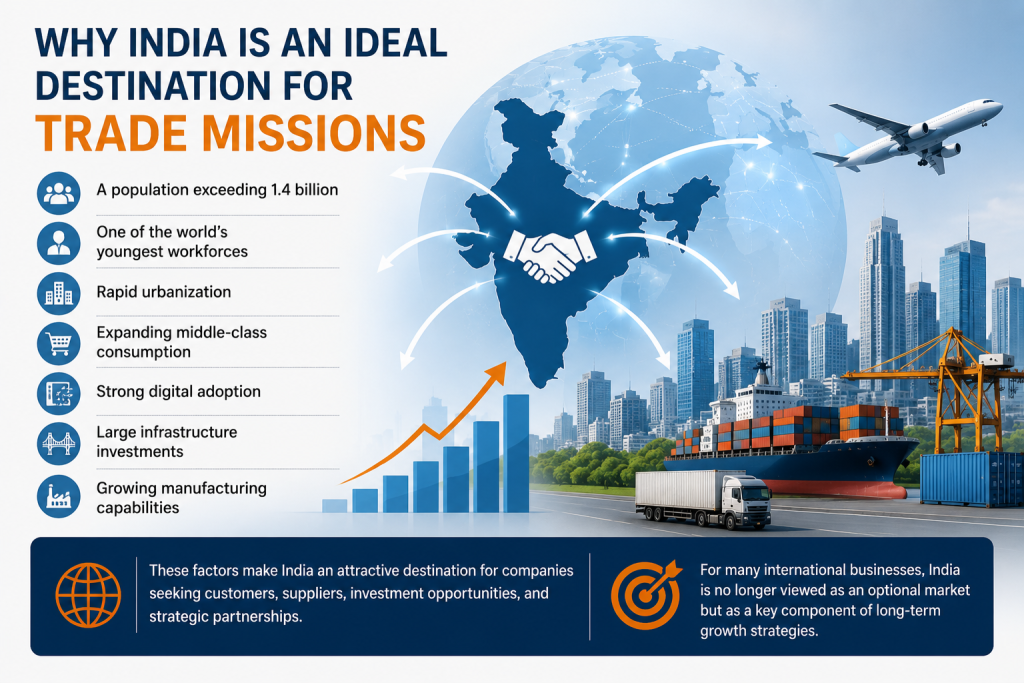
Why India Is an Ideal Destination for Trade Missions

Key Objectives of a Business Visit to India

Every delegation has different goals, but most business visits focus on one or more of the following objectives.

Exploring Market Opportunities

A market visit allows companies to understand local demand, customer preferences, pricing structures, competitive dynamics, and industry trends.

Direct exposure to the market often reveals opportunities that cannot be identified through desk research alone.

Finding Business Partners

Many foreign companies enter India through:

  • Distributors
  • Dealers
  • Importers
  • Joint venture partners
  • Contract manufacturers
  • Strategic alliances

Meeting potential partners personally helps assess capabilities, credibility, and long-term compatibility.

Evaluating Suppliers and Manufacturers

For companies considering sourcing from India, factory visits are essential.

Site visits allow businesses to evaluate:

  • Production capabilities
  • Quality systems
  • Certifications
  • Workforce skills
  • Capacity levels
  • Compliance standards

This reduces sourcing risks and improves supplier selection decisions.

Understanding Regulatory Requirements

Business visits also provide opportunities to meet industry experts, advisors, and government stakeholders who can explain regulatory procedures and market-entry requirements.


How to Plan a Successful Trade Mission to India

The effectiveness of a delegation depends largely on preparation.

Define Clear Objectives

Companies should identify specific goals before traveling.

Examples include:

  • Finding distributors
  • Identifying sourcing partners
  • Exploring investments
  • Meeting government agencies
  • Attending trade exhibitions
  • Conducting market research

Clearly defined objectives help maximize the value of the visit.

Select the Right Cities

India is not a single market.

Different cities specialize in different industries.

For example:

  • Mumbai – Financial services, media, consumer goods
  • Bengaluru – Technology, startups, AI
  • Delhi NCR – Government relations, trade, services
  • Chennai – Automotive and manufacturing
  • Hyderabad – Pharmaceuticals and life sciences
  • Ahmedabad – Chemicals and engineering
  • Pune – Industrial manufacturing

Selecting the right locations is critical to achieving delegation objectives.

Schedule Meetings in Advance

One of the biggest mistakes international companies make is arriving without confirmed appointments.

Successful delegations typically arrange meetings several weeks in advance to ensure access to relevant stakeholders.


The Importance of B2B Matchmaking During Business Visits

A well-organized delegation should include structured B2B matchmaking.

Rather than relying on random networking opportunities, companies benefit from targeted introductions based on:

  • Industry sector
  • Business objectives
  • Investment interests
  • Product categories
  • Geographic priorities

Professional matchmaking significantly improves the quality of meetings and increases the likelihood of commercial outcomes.

Importance of B2B Matchmaking During Business Visits

Trade Shows and Industry Events as Part of Market Visits

India hosts thousands of trade fairs, exhibitions, industry conferences, and business events every year.

These events provide access to:

  • Buyers
  • Suppliers
  • Industry experts
  • Investors
  • Government representatives

Combining a market visit with participation in a relevant trade show often produces stronger results than either activity alone.

Many successful market-entry projects begin with a delegation visit centered around a major industry exhibition.


Common Challenges Faced by International Delegations

Although India offers substantial opportunities, international visitors often encounter practical challenges.

These may include:

  • Identifying the right companies
  • Coordinating meetings across cities
  • Managing travel logistics
  • Understanding local business culture
  • Language differences in certain regions
  • Verifying suppliers and partners
  • Following up after meetings

Without local support, these challenges can reduce the effectiveness of a business visit.


Why Local Delegation Support Makes a Difference

Professional delegation support helps companies maximize the return on their visit.

Local experts can assist with:

  • Market research
  • Meeting scheduling
  • B2B matchmaking
  • Partner identification
  • Factory visit coordination
  • Trade show planning
  • Translation support
  • Transportation logistics
  • Follow-up management

This ensures that companies spend more time developing business opportunities and less time managing operational details.


How India Market Entry Supports Business Delegations and Market Visits

At India Market Entry, we help international companies plan, organize, and execute successful business visits across India.

Our delegation support services include:

  • Market visit planning
  • Business matchmaking
  • Partner and distributor identification
  • Supplier search and verification
  • Trade mission organization
  • Trade fair support
  • Factory visit coordination
  • Government and industry meetings
  • Travel and logistics management
  • Follow-up support after the visit

Whether you are exploring India for the first time or conducting a targeted trade mission, our team helps ensure that every meeting, site visit, and business interaction contributes to your market-entry objectives.

By combining local market knowledge, extensive business networks, and practical on-ground support, we help international companies convert market visits into tangible business opportunities.


Final Thoughts

India offers enormous opportunities for international businesses, but successful market entry often begins with a well-planned visit.

Business delegations and market visits provide valuable insights, facilitate relationship building, accelerate partner identification, and reduce market-entry risks.

Companies that invest time in understanding the market firsthand are often better positioned to make informed decisions and establish successful long-term operations.

As India continues to emerge as one of the world’s most important business destinations, strategic business visits will remain one of the most effective ways for international companies to explore opportunities and build a strong presence in the market.
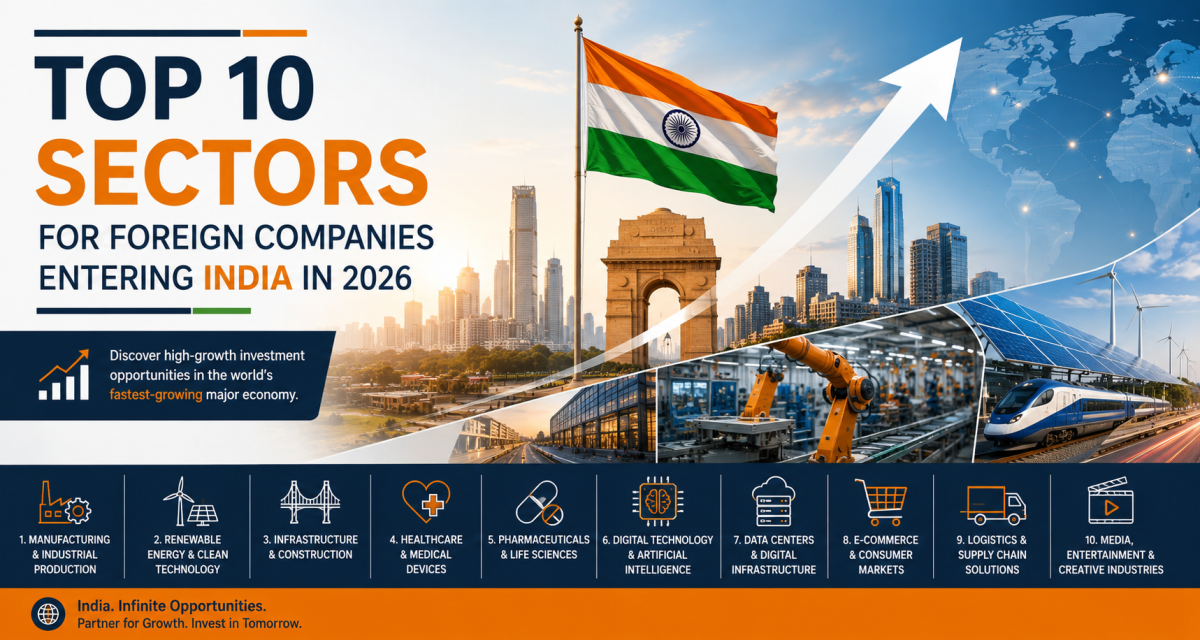

Top 10 Sectors for Foreign Companies Entering India in 2026

India has emerged as one of the world’s most attractive destinations for foreign investment. As the world’s fifth-largest economy with a GDP exceeding USD 4 trillion, India continues to outperform many major economies in terms of growth, consumption, infrastructure development, digital transformation, and industrial expansion.

The country’s large domestic market, favorable demographics, government-led reforms, improving business environment, and strong investment inflows have created significant opportunities for international companies across multiple industries.

For foreign businesses evaluating expansion into Asia, India is no longer simply a future opportunity—it is increasingly becoming a present-day strategic priority.

This article highlights the ten sectors expected to offer the strongest growth and investment opportunities for foreign companies entering India in 2026.


1. Manufacturing and Industrial Production

Manufacturing remains one of India’s highest-priority sectors.

Government initiatives such as Make in India, Production Linked Incentive (PLI) schemes, industrial corridor development, and logistics modernization are attracting global manufacturers across multiple industries.

Strong opportunities exist in:

  • Electronics
  • Automotive components
  • Engineering products
  • Industrial machinery
  • Chemicals
  • Consumer goods
  • Textiles

As companies diversify supply chains beyond China, India is increasingly benefiting from global manufacturing relocation strategies.

Foreign companies seeking contract manufacturing, supplier partnerships, or greenfield investments are finding growing opportunities across India’s industrial ecosystem.


2. Renewable Energy and Clean Technology

India has become one of the world’s fastest-growing renewable energy markets.

The country has set ambitious clean energy targets and continues investing heavily in solar, wind, battery storage, green hydrogen, and electric mobility infrastructure.

Investment opportunities exist in:

  • Solar equipment manufacturing
  • Energy storage systems
  • EV charging infrastructure
  • Green hydrogen projects
  • Smart grid technologies
  • Renewable energy services

As sustainability becomes a global priority, India’s clean energy sector is expected to attract substantial foreign capital over the coming decade.


3. Infrastructure and Construction

India is currently undertaking one of the largest infrastructure expansion programs in the world.

Government spending on roads, railways, airports, ports, industrial corridors, urban development, and logistics infrastructure continues to rise.

Opportunities are particularly strong in:

  • Engineering services
  • Construction technology
  • Building materials
  • Smart city solutions
  • Industrial parks
  • Logistics infrastructure

For global infrastructure companies, India offers a long-term growth market supported by significant public and private investment.


4. Healthcare and Medical Devices

India’s healthcare sector is undergoing rapid modernization.

Growing incomes, urbanization, healthcare awareness, and increased government spending are driving demand for hospitals, medical technologies, diagnostics, and healthcare services.

Foreign companies are finding opportunities in:

  • Medical devices
  • Healthcare technology
  • Diagnostics
  • Telemedicine
  • Hospital infrastructure
  • Specialty healthcare services

India’s healthcare market is expected to continue expanding significantly through 2030 and beyond.


5. Pharmaceuticals and Life Sciences

India is already one of the world’s leading pharmaceutical manufacturing hubs and a major supplier of generic medicines globally.

The country possesses strong capabilities in:

  • Active Pharmaceutical Ingredients (APIs)
  • Generic drugs
  • Contract manufacturing
  • Biotechnology
  • Clinical research

Government support and increasing global demand for healthcare products continue to strengthen investment opportunities in this sector.


6. Digital Technology and Artificial Intelligence

India’s digital economy has become one of the fastest-growing globally.

The country’s large technology talent pool, thriving startup ecosystem, and increasing enterprise digitalization are driving growth in:

  • Artificial Intelligence
  • Software development
  • Cloud computing
  • Cybersecurity
  • SaaS solutions
  • Data analytics
  • Enterprise technology services

Global technology companies continue expanding operations in India to access both talent and market opportunities.


7. Data Centers and Digital Infrastructure

Rapid digital adoption is fueling demand for data centers and digital infrastructure.

Growth in cloud computing, AI applications, OTT platforms, e-commerce, fintech, and enterprise software is creating significant investment requirements.

Opportunities include:

  • Data center development
  • Cloud infrastructure
  • Network equipment
  • Fiber connectivity
  • Digital infrastructure services

India is expected to become one of Asia’s largest data center markets over the next decade.


8. E-Commerce and Consumer Markets

India’s consumer market remains one of the country’s biggest attractions for foreign investors.

A growing middle class, rising disposable incomes, increasing internet penetration, and changing consumer preferences continue to drive demand.

Opportunities exist across:

  • Retail
  • E-commerce
  • Consumer electronics
  • Personal care products
  • Food and beverages
  • Home improvement products

Companies entering India today gain access to one of the world’s largest consumer bases.


9. Logistics and Supply Chain Solutions

India’s logistics sector is undergoing significant transformation.

Government initiatives such as PM Gati Shakti, Dedicated Freight Corridors, Bharatmala, Sagarmala, and the National Logistics Policy are improving efficiency and reducing transportation costs.

Opportunities exist in:

  • Warehousing
  • Cold chain solutions
  • Supply chain technology
  • Freight services
  • Last-mile delivery
  • Logistics automation

As manufacturing and e-commerce continue to grow, demand for modern logistics solutions is expected to increase substantially.


10. Media, Entertainment and Creative Industries

India’s media and entertainment industry has expanded far beyond traditional film and television.

Today, growth is being driven by:

  • Streaming platforms
  • Digital content production
  • Gaming
  • Animation
  • Visual effects
  • Advertising
  • Creator economy businesses

International production companies, broadcasters, content platforms, and creative businesses increasingly view India as both a production hub and a major consumer market.

The combination of skilled talent, competitive production costs, and a large digital audience creates significant opportunities for foreign investment.


Why India Continues to Attract Global Investment

Several structural advantages continue to strengthen India’s attractiveness for international businesses.

These include:

  • A population exceeding 1.4 billion
  • One of the world’s youngest workforces
  • Strong economic growth
  • Expanding middle-class consumption
  • Increasing infrastructure investment
  • Government support for foreign investment
  • Improving ease of doing business
  • Rapid digital transformation

Together, these factors make India one of the most compelling long-term investment destinations globally.


How India Market Entry Helps Foreign Companies Enter India

While the opportunities are substantial, entering India successfully requires local knowledge, market intelligence, and reliable business networks.

At India Market Entry, we help international companies identify opportunities, evaluate sectors, connect with potential partners, and navigate the Indian market efficiently.

Our services include:

  • Market research and opportunity assessment
  • Partner and distributor search
  • Business matchmaking
  • Representation services
  • Investment support
  • Trade mission coordination
  • Business visit planning
  • Sector-specific market intelligence

Whether you are evaluating manufacturing, infrastructure, technology, healthcare, renewable energy, consumer markets, or other growth sectors, our team helps accelerate your market-entry journey and reduce business risks.

How India market entry helps companies

Final Thoughts

India’s economic transformation is creating opportunities across a wide range of industries. For foreign companies looking beyond mature markets and seeking long-term growth, few countries can match India’s combination of market size, economic momentum, talent availability, and investment potential.

The most successful companies will be those that identify opportunities early, establish local relationships, and build a clear market-entry strategy.

As India continues its rise as a global economic powerhouse, the sectors highlighted above are expected to remain among the most attractive destinations for foreign investment in 2026 and beyond.

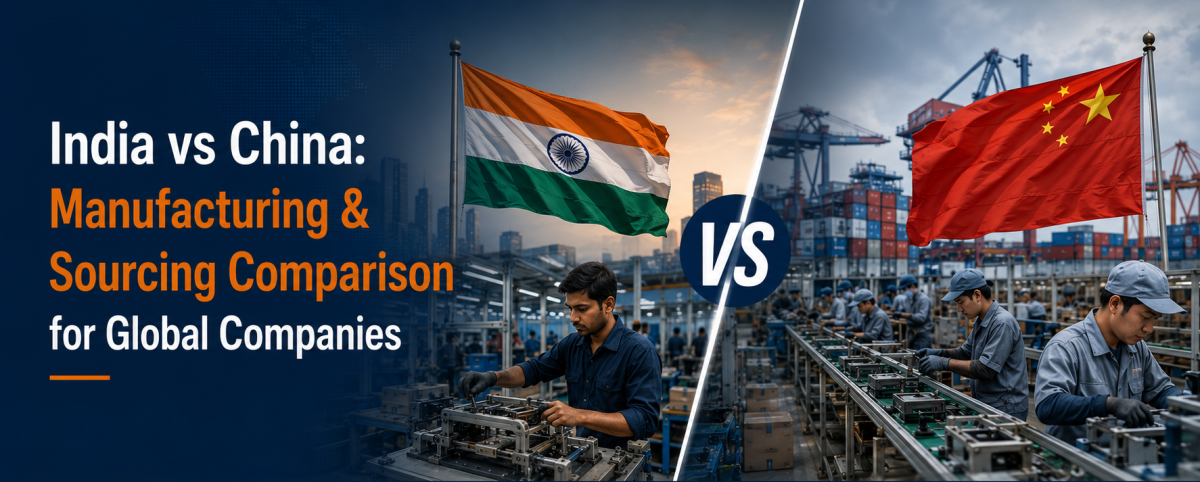
India vs China: Manufacturing & Sourcing Comparison for Global Companies

For more than three decades, China has been the world’s manufacturing powerhouse. Its extensive industrial ecosystem, large-scale production capabilities, advanced infrastructure, and export-oriented economy transformed the country into the preferred sourcing destination for global companies.

However, the global manufacturing landscape is changing.

Rising labor costs in China, geopolitical tensions, supply chain disruptions, trade restrictions, and increasing demand for supply chain diversification have prompted multinational companies to explore alternative manufacturing destinations.

As a result, India has emerged as one of the most promising sourcing and manufacturing alternatives to China.

Today, many global businesses are adopting a “China Plus One” strategy, maintaining operations in China while expanding sourcing and manufacturing activities into countries such as India, Vietnam, Mexico, and Indonesia.

Among these alternatives, India stands out because of its large workforce, expanding manufacturing base, government incentives, growing domestic market, and long-term economic potential.

This article compares India and China across key manufacturing and sourcing factors to help global companies make informed supply chain decisions.


Why Global Companies Are Looking for Sourcing Alternatives to China

The shift away from exclusive dependence on China is being driven by multiple factors.

Average manufacturing wages in China have increased significantly over the past decade, reducing some of the cost advantages that originally attracted global manufacturers.

At the same time, trade tensions between major economies, particularly the United States and China, have increased uncertainty for international supply chains.

The COVID-19 pandemic further exposed the risks of concentrating production in a single country, leading many businesses to rethink sourcing strategies and improve supply chain resilience.

As a result, companies across industries including electronics, machinery, consumer products, automotive components, textiles, healthcare, and industrial goods are actively evaluating alternative sourcing destinations.


India vs China Manufacturing: Labor Costs and Workforce Availability

Labor costs remain one of the most important considerations for manufacturers.

China’s manufacturing workforce has become increasingly skilled, but labor costs have risen substantially as the country’s economy has matured.

India, by comparison, continues to offer a significant labor cost advantage in many manufacturing sectors.

India also benefits from one of the world’s youngest populations, with a median age of approximately 29 years compared to China’s aging workforce.

Every year, millions of young workers enter India’s labor market, creating a large talent pool for manufacturing industries.

For labor-intensive industries such as textiles, apparel, footwear, furniture, consumer goods, and assembly operations, India offers attractive cost advantages.

Advantage: India


India vs China Manufacturing Infrastructure Comparison

Infrastructure has traditionally been one of China’s strongest competitive advantages.

China possesses highly developed ports, highways, industrial parks, rail networks, and logistics systems that support large-scale manufacturing and exports.

India has historically lagged behind in this area, but significant investments are rapidly narrowing the gap.

Government initiatives such as PM Gati Shakti, Bharatmala, Dedicated Freight Corridors, Industrial Corridors, Sagarmala, and National Logistics Policy are transforming India’s infrastructure landscape.

India is investing billions of dollars annually in roads, ports, airports, logistics hubs, and industrial parks to improve manufacturing competitiveness.

While China still maintains an advantage in infrastructure maturity, India’s progress is creating increasingly attractive conditions for global manufacturers.

Advantage: China (currently), India (rapidly improving)


Supply Chain Ecosystem: India vs China Manufacturing Capabilities

China’s biggest strength remains its manufacturing ecosystem.

In many industries, suppliers, component manufacturers, assembly facilities, logistics providers, and exporters operate within tightly integrated industrial clusters.

This creates significant efficiency advantages.

India’s manufacturing ecosystem is expanding rapidly but remains less integrated than China’s in certain sectors.

However, India has developed strong capabilities in:

  • Pharmaceuticals
  • Automotive components
  • Chemicals
  • Engineering goods
  • Textiles and apparel
  • Electronics assembly
  • Renewable energy equipment
  • Industrial machinery

As more global companies establish operations in India, supplier networks continue to strengthen.

Advantage: China


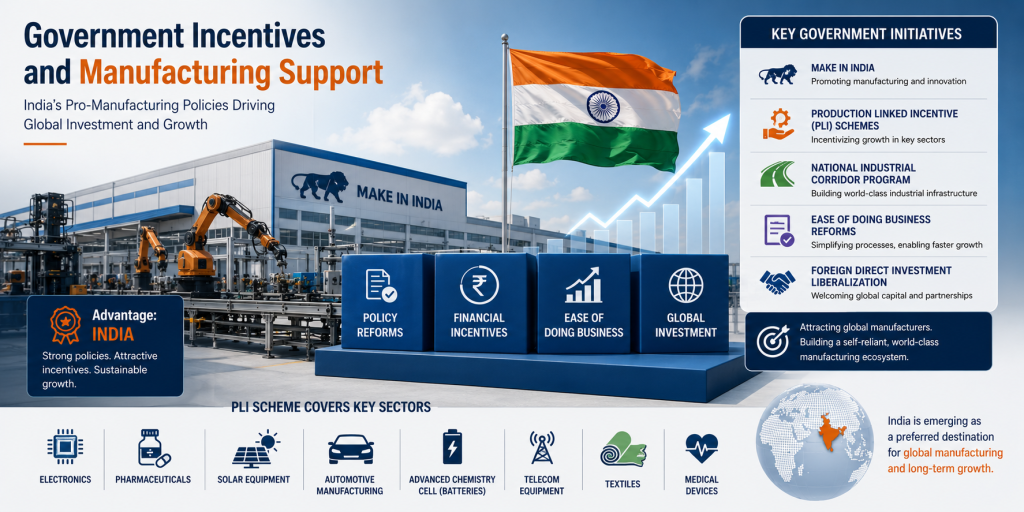
Government Incentives and Manufacturing Support

India has introduced aggressive policies to attract global manufacturers.

Programs such as:

  • Make in India
  • Production Linked Incentive (PLI) Schemes
  • National Industrial Corridor Program
  • Ease of Doing Business Reforms
  • Foreign Direct Investment Liberalization

have significantly improved India’s attractiveness for international investors.

The Production Linked Incentive (PLI) scheme alone covers multiple sectors including electronics, pharmaceuticals, solar equipment, automotive manufacturing, batteries, telecom equipment, textiles, and medical devices.

These incentives are encouraging both foreign investment and domestic manufacturing expansion.

China continues to provide support for manufacturing industries, but India’s incentive programs are increasingly attracting global attention.

Advantage: India

Government Incentives and Manufacturing Support

Domestic Market Potential: India vs China

For many manufacturers, production decisions are increasingly linked to local market opportunities.

China remains one of the world’s largest consumer markets, but economic growth has moderated in recent years.

India, on the other hand, is expected to remain one of the fastest-growing major economies globally.

With a population exceeding 1.4 billion and a rapidly expanding middle class, India offers manufacturers the dual advantage of serving both export markets and domestic consumers.

Many international companies now view India not only as a sourcing destination but also as a strategic long-term growth market.

Advantage: India (future growth potential)


Geopolitical Risk and Supply Chain Resilience

Geopolitical risk has become a major factor in sourcing decisions.

Companies increasingly seek diversified supply chains to reduce exposure to trade disputes, tariffs, sanctions, political tensions, and unexpected disruptions.

India is generally viewed as a stable and strategically important partner for many global economies.

The country’s strong diplomatic relationships and growing integration with international supply chains make it an attractive location for supply chain diversification.

For companies implementing a China Plus One strategy, India often becomes a preferred secondary manufacturing base.

Advantage: India


Ease of Doing Business: India vs China

Both countries have undertaken significant reforms to improve business environments.

China benefits from decades of manufacturing experience and highly efficient industrial zones.

India has made substantial progress in simplifying regulations, digitizing government services, improving customs procedures, and streamlining investment processes.

Although administrative processes can still vary across Indian states, the overall business environment has improved significantly.

Many global investors now report much smoother market entry experiences compared with previous decades.

Advantage: China (current execution), India (improving rapidly)


Which Industries Should Consider India as a China Alternative?

India is particularly attractive for companies involved in:

  • Textiles and apparel
  • Pharmaceuticals
  • Medical devices
  • Engineering products
  • Automotive components
  • Chemicals
  • Building materials
  • Renewable energy equipment
  • Electronics assembly
  • Consumer goods

These sectors benefit from India’s labor availability, government incentives, growing supplier base, and export competitiveness.


Why Global Companies Are Adopting a China Plus One Strategy

The reality is that most multinational companies are not completely replacing China.

Instead, they are diversifying.

A China Plus One strategy allows companies to maintain access to China’s established manufacturing ecosystem while simultaneously building additional capacity in alternative locations such as India.

This approach helps:

  • Reduce supply chain risk
  • Improve business continuity
  • Increase sourcing flexibility
  • Access new markets
  • Optimize manufacturing costs

For many businesses, India has become the preferred destination for implementing this strategy.


How India Market Entry Helps Global Companies Source from India

Successfully sourcing from India requires more than identifying suppliers online.

Finding reliable manufacturers, conducting due diligence, assessing production capabilities, managing supplier relationships, and understanding local business practices are critical to long-term success.

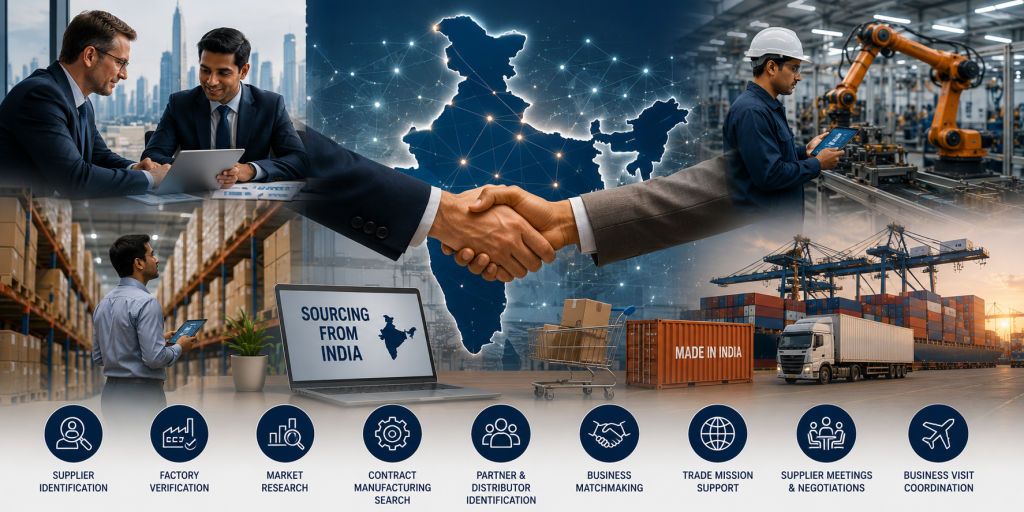
At India Market Entry, we help international companies identify sourcing opportunities and establish reliable supplier networks across India.

Our services include:

  • Supplier identification
  • Factory verification
  • Market research
  • Contract manufacturing search
  • Partner and distributor identification
  • Business matchmaking
  • Trade mission support
  • Supplier meetings and negotiations
  • Business visit coordination

Whether you are exploring India as a sourcing destination or implementing a China Plus One strategy, our team helps you navigate the market and connect with trusted manufacturing partners.

How India Market Entry Helps Global Companies Source from India

Final Thoughts

China remains one of the world’s most important manufacturing economies, with unmatched industrial depth and mature supply chains.

However, the global sourcing landscape is evolving.

India’s competitive labor costs, large workforce, strong economic growth, government incentives, expanding infrastructure, and growing manufacturing ecosystem have positioned the country as one of the most attractive sourcing alternatives to China.

For global companies seeking resilience, diversification, and long-term growth opportunities, the question is no longer whether India should be part of the supply chain strategy—it is how quickly they can establish a meaningful presence in one of the world’s fastest-growing manufacturing destinations.

Why Local Representation Matters When Doing Business in India

India has become one of the world’s most attractive business destinations. As the fifth-largest economy globally, with a GDP exceeding USD 4 trillion, the country offers significant opportunities across manufacturing, technology, infrastructure, healthcare, renewable energy, consumer goods, and professional services.

India attracted over USD 80 billion in Foreign Direct Investment (FDI) annually in recent years and continues to be viewed as one of the most promising long-term growth markets for international companies. The country’s large consumer base, expanding middle class, rapid urbanization, and government-led reforms have strengthened its position as a preferred destination for global businesses seeking growth in Asia.

However, entering India is not simply a matter of identifying customers and establishing operations. India’s market is complex, highly relationship-driven, regionally diverse, and often requires continuous local engagement to achieve sustainable business success.

This is why many international companies choose to work with local representatives in India before committing to a permanent office, subsidiary, or large-scale investment.


Understanding the Complexity of the Indian Market

India is often described as a single market, but in reality it operates more like a collection of multiple regional markets.

The country has 28 states, several union territories, hundreds of major cities, diverse business cultures, and significant differences in consumer behavior, language preferences, regulatory environments, and purchasing patterns.

A strategy that works in Mumbai may not necessarily work in Chennai. Business practices in Bengaluru may differ significantly from those in Kolkata or Ahmedabad.

For foreign companies unfamiliar with these dynamics, navigating the market can be challenging without local guidance and representation.

Local representatives help bridge these gaps by providing market knowledge, business intelligence, cultural understanding, and direct access to relevant stakeholders.


Why Relationship Building Is Critical in India

While digital communication has transformed global business, personal relationships continue to play a vital role in India.

Business decisions are frequently influenced by trust, credibility, reputation, and long-term relationship building.

Many Indian companies prefer engaging with businesses that demonstrate a long-term commitment to the market rather than those approaching opportunities from a purely transactional perspective.

Having a local representative helps international companies maintain regular engagement with potential customers, distributors, government agencies, industry associations, and strategic partners.

This ongoing presence often accelerates trust-building and improves conversion rates for business opportunities.


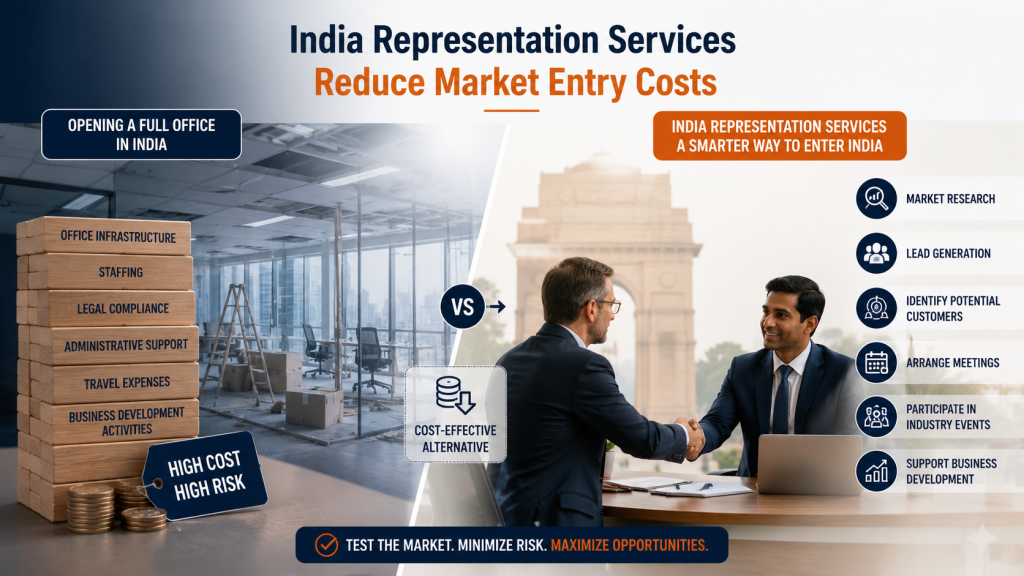
India Representation Services Reduce Market Entry Costs

Opening a full office in a new country requires substantial investment.

Costs typically include:

  • Office infrastructure
  • Staffing
  • Legal compliance
  • Administrative support
  • Travel expenses
  • Business development activities

For many companies exploring India for the first time, these costs may not be justified during the initial market assessment phase.

India representation services provide a practical alternative.

Instead of establishing an immediate physical presence, international companies can utilize a local representative to:

  • Conduct market research
  • Generate business leads
  • Identify potential customers
  • Arrange meetings
  • Participate in industry events
  • Support business development efforts

This approach allows businesses to test the market while minimizing risk and overhead costs.

India Representation Services Reduce Market Entry Costs

Faster Access to Decision Makers

One of the biggest challenges for foreign companies entering India is identifying the right stakeholders.

Whether the objective is finding distributors, sourcing partners, government contacts, investors, or end customers, building a network from scratch can take significant time.

A local representative often brings established relationships and industry connections that can shorten the business development cycle considerably.

This is particularly important in sectors such as:

  • Manufacturing
  • Infrastructure
  • Healthcare
  • Renewable energy
  • Construction
  • Technology
  • Education
  • Consumer products

Access to the right decision makers can significantly improve market-entry outcomes and reduce time-to-market.


Managing Regulatory and Administrative Challenges

India has made significant progress in improving its business environment and digital governance systems.

However, regulatory processes can still be challenging for foreign companies unfamiliar with local requirements.

Businesses may encounter issues related to:

  • Product registrations
  • Certifications
  • Import procedures
  • Industry-specific regulations
  • State-level approvals
  • Tender participation requirements

A local representative can help coordinate with relevant authorities, provide guidance on procedures, and ensure smoother communication with stakeholders.

This support reduces delays and helps companies navigate administrative requirements more effectively.


Supporting Business Development and Partner Search

Finding reliable partners remains one of the most important aspects of successful market entry.

Many international companies seek:

  • Distributors
  • Dealers
  • Importers
  • Manufacturers
  • Contract manufacturers
  • Joint venture partners
  • Service providers

Identifying suitable partners requires more than online research.

A local representative can conduct background verification, arrange meetings, assess business capabilities, and help evaluate potential partnerships.

This reduces risk and improves the quality of business relationships established in the market.


Why Local Representation Is Important for Trade Shows and Business Visits in India

India hosts thousands of trade fairs, industry conferences, B2B meetings, and investment events every year.

While participation in these events can generate valuable business opportunities, maximizing outcomes often requires local preparation and follow-up.

A local representative can assist with:

  • Identifying relevant events
  • Scheduling meetings in advance
  • Coordinating business visits
  • Following up with prospects
  • Managing local logistics

This ensures that companies derive greater value from their business development activities.

Why Local Representation Is Important for Trade Shows and Business Visits in India

The Growing Importance of On-Ground Presence in India’s Business Environment

As competition increases across sectors, companies that maintain a visible local presence often achieve better results than those relying solely on remote engagement.

Customers, distributors, and business partners generally respond more positively when there is a dedicated point of contact within the country.

Even without a physical office, a local representative provides the perception of accessibility, commitment, and responsiveness.

For many international businesses, this can become a significant competitive advantage.


Industries Where India Representation Services Deliver Strong Value

Local representation can benefit companies across multiple sectors.

Particularly strong demand exists among businesses involved in:

  • Manufacturing and sourcing
  • Building materials
  • Infrastructure and construction
  • Renewable energy
  • Healthcare and pharmaceuticals
  • Technology and software
  • Industrial machinery
  • Consumer goods
  • Education and training
  • Professional services

In each of these sectors, relationship building, local market knowledge, and stakeholder engagement play a critical role in business success.


Why International Companies Choose India Market Entry as Their Local Representative

At India Market Entry, we help international businesses establish a professional presence in India without the need for immediate investment in a local office.

Our representation services are designed to help foreign companies identify opportunities, build relationships, and navigate the Indian market effectively.

We support clients through:

  • Market research and opportunity assessment
  • Lead generation and business development
  • Distributor and partner search
  • Business matchmaking
  • Trade show representation
  • Government and industry engagement
  • Meeting coordination
  • Business visit support
  • Ongoing market representation

Acting as an extension of your team, we provide local knowledge, industry networks, and on-ground support to help accelerate your India market-entry journey.

Whether you are exploring opportunities, seeking partners, developing customers, or preparing for expansion, our representation services provide a cost-effective and practical pathway into one of the world’s fastest-growing markets.


Final Thoughts

India offers enormous opportunities for international businesses, but success requires more than identifying demand. It requires understanding the market, building relationships, maintaining local engagement, and navigating a complex business environment.

For many companies, local representation serves as the bridge between market exploration and long-term business success.

By partnering with a trusted local representative, international businesses can reduce risks, accelerate market access, strengthen stakeholder relationships, and create a stronger foundation for sustainable growth in India.

As India continues to attract global investment and expand its role in international trade, companies that establish an effective local presence today will be better positioned to capitalize on future opportunities.

How International Companies Can Explore India Efficiently in 2026

India has emerged as one of the world’s most attractive destinations for international businesses seeking growth, manufacturing opportunities, sourcing partnerships, and new customers. With a population exceeding 1.4 billion, a rapidly growing middle class, and one of the fastest-growing major economies, India offers opportunities across manufacturing, technology, infrastructure, retail, healthcare, renewable energy, and consumer goods.

According to the latest estimates from the International Monetary Fund, India is expected to remain among the fastest-growing major economies globally, with GDP growth projected above 6% in 2026. Foreign Direct Investment (FDI) inflows into India have crossed USD 1 trillion cumulatively since 2000, reflecting sustained international confidence in the Indian market.

However, entering India successfully requires more than reading market reports. International companies that achieve long-term success typically combine structured India market research, carefully planned India business visits, and local partnership development before making major investments.

This guide explains how foreign businesses can explore India efficiently while minimizing risks and maximizing opportunities.


Why India Continues to Attract Global Businesses

Why India Continues to Attract Global Businesses

India offers several advantages that distinguish it from other emerging markets:

  • Large domestic consumer market
  • Competitive manufacturing ecosystem
  • Skilled workforce and engineering talent
  • Expanding digital economy
  • Government-led infrastructure investments
  • Strong startup and innovation ecosystem
  • Growing export capabilities

India’s economy is expected to exceed USD 5 trillion in the coming years, creating substantial opportunities for international businesses looking for long-term growth.

For many foreign companies, India is no longer viewed solely as a sourcing destination. It is increasingly becoming a strategic market for sales, manufacturing, R&D, and regional headquarters.


Start with Comprehensive India Market Research

Before scheduling meetings or opening an office, businesses should invest time in structured India market research.

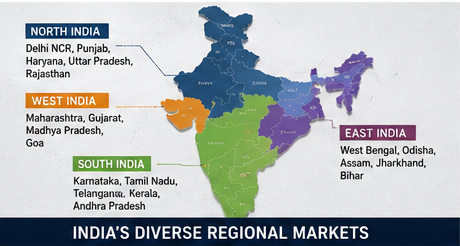
Many companies make the mistake of assuming that India functions as a single homogeneous market. In reality, India is a collection of diverse regional markets, languages, consumer behaviors, and business cultures.

Key areas to evaluate include:

Market Demand

Understand:

  • Current market size
  • Industry growth rates
  • Customer segments
  • Regional demand variations
  • Price sensitivity

For example, demand patterns in Delhi may differ significantly from those in Bengaluru, Mumbai, Chennai, or Kolkata.

Competitive Landscape

Research should identify:

  • Local competitors
  • International players already operating in India
  • Distribution models
  • Pricing strategies
  • Market share leaders

A detailed competitor analysis often reveals opportunities that may not be visible through public reports alone.

Regulatory Environment

International businesses should understand:

  • Import regulations
  • Product certification requirements
  • Taxation framework
  • Industry-specific licensing requirements
  • State-level regulations

Proper market research helps avoid costly delays later in the expansion process.


Plan Strategic India Business Visits

India business visit support company

While digital meetings are useful, nothing replaces on-the-ground experience.

A well-planned India business visit allows companies to:

  • Meet potential distributors
  • Visit manufacturing facilities
  • Conduct supplier audits
  • Understand customer behavior
  • Explore industrial clusters
  • Evaluate logistics infrastructure

Successful business visits typically combine multiple objectives into a single trip.

Instead of visiting only one city, international companies often schedule meetings across key business hubs to gain a broader understanding of market opportunities.


Identify the Right Cities for Your Industry

India’s economic strengths vary significantly by region.

Delhi NCR

New Delhi and the wider NCR region are major centers for:

  • Government relations
  • Infrastructure projects
  • Professional services
  • Manufacturing
  • Trade organizations

Mumbai

Mumbai serves as India’s financial capital and is ideal for:

  • Financial services
  • Consumer brands
  • Media and entertainment
  • Corporate headquarters

Bengaluru

Bengaluru is known for:

  • Technology
  • Software development
  • Startups
  • Innovation ecosystems

Chennai

Chennai specializes in:

  • Automotive manufacturing
  • Electronics
  • Industrial production

Hyderabad

Hyderabad is a growing hub for:

  • Pharmaceuticals
  • Biotechnology
  • IT services

Selecting the right cities can significantly improve the effectiveness of India business visits.


Meet Potential Partners Before Making Commitments

One of the most effective ways to accelerate India expansion is through local partnerships.

Potential partners may include:

  • Distributors
  • Importers
  • Manufacturers
  • Agents
  • Joint venture partners
  • Service providers

During business visits, companies should evaluate:

  • Financial stability
  • Market reputation
  • Distribution reach
  • Existing customer base
  • Industry expertise

Face-to-face meetings often provide insights that cannot be obtained through online research alone.


Visit Industrial Clusters and Manufacturing Hubs

India’s industrial ecosystem is concentrated in specialized clusters.

Examples include:

  • Automotive manufacturing in Tamil Nadu
  • Textiles in Gujarat
  • Pharmaceuticals in Hyderabad
  • Electronics in Noida
  • Ceramics in Morbi
  • Engineering products in Pune

Factory visits help companies assess:

  • Production capacity
  • Quality standards
  • Compliance procedures
  • Workforce skills
  • Supply chain reliability

For sourcing and manufacturing projects, site inspections are essential before entering long-term agreements.


Participate in Trade Shows and Industry Events

Participate in Trade Shows and Industry Events in India support services companies in india

India hosts hundreds of international exhibitions and trade fairs annually.

Benefits include:

  • Meeting multiple suppliers in one location
  • Understanding market trends
  • Discovering new technologies
  • Building industry networks
  • Identifying competitors

Many foreign companies combine trade show participation with factory visits and business matchmaking programs to maximize efficiency.


Conduct Professional Business Matchmaking

Finding reliable partners independently can be challenging.

Professional business matchmaking services help international companies:

  • Identify qualified prospects
  • Schedule targeted meetings
  • Screen potential partners
  • Arrange factory visits
  • Organize B2B sessions

This approach significantly reduces the time required to enter the market and helps avoid unsuitable partnerships.

Organizations such as Federation of Indian Export Organisations, industry associations, chambers of commerce, and specialized consulting firms often facilitate these introductions.


Understand India’s Regional Business Culture

India’s diversity creates unique opportunities but also requires cultural awareness.

International companies should consider:

  • Regional communication styles
  • Decision-making processes
  • Relationship-building practices
  • Local negotiation approaches
  • Business etiquette

Building trust remains a critical factor in successful business relationships across India.

Companies that invest time in relationship development often achieve better long-term outcomes than those focused solely on short-term transactions.


Develop a Phased India Expansion Strategy

Rather than making large investments immediately, many successful international companies adopt a phased approach.

Phase 1: Market Research

  • Industry assessment
  • Competitive analysis
  • Opportunity identification

Phase 2: India Business Visits

  • Meetings with stakeholders
  • Site inspections
  • Market validation

Phase 3: Pilot Market Entry

  • Distributor appointment
  • Limited product launch
  • Market testing

Phase 4: Local Presence

  • Representative office
  • Sales office
  • Manufacturing facility
  • Joint venture

This staged strategy reduces risk while allowing companies to build local knowledge gradually.


Key Mistakes International Companies Should Avoid

Common challenges include:

Assuming India Is One Market

Regional differences can significantly affect sales strategies.

Choosing Partners Too Quickly

Partner selection should involve due diligence and multiple interactions.

Relying Only on Online Research

Market realities are best understood through field visits and direct engagement.

Ignoring Local Regulations

Regulatory requirements vary across sectors and should be reviewed carefully.

Underestimating Relationship Building

Trust and long-term engagement often play a major role in business success.


Why On-Ground Exploration Matters More Than Ever

As global companies diversify supply chains and seek new growth markets, India is increasingly viewed as both a manufacturing hub and a major consumer market.

The most successful entrants typically combine:

  • Comprehensive India market research
  • Structured India business visits
  • Direct engagement with local stakeholders
  • Strategic partner identification
  • Phased India expansion planning

Companies that invest time in understanding India’s business environment before committing resources are often better positioned to capture opportunities and achieve sustainable growth.

For international businesses evaluating Asia-Pacific expansion strategies, India remains one of the most compelling destinations for long-term investment, partnership development, sourcing, and market growth.

Why India’s Media & Creative Industry Is Attracting Global Attention

India is one of the world’s fastest-growing media and entertainment markets, offering significant opportunities for international production companies, broadcasters, streaming platforms, advertising agencies, content creators, and creative businesses.

Traditionally known for its film industry, India has evolved into a diverse creative ecosystem encompassing television, OTT platforms, digital content, animation, gaming, visual effects, advertising, music, and creator-driven media. With a population exceeding 1.4 billion and one of the world’s largest digital audiences, India is not only a major consumer market but also an increasingly important production hub for global content.

The rapid growth of internet connectivity, smartphone adoption, and streaming services has transformed content consumption patterns across the country. As international media companies seek new markets and cost-effective production destinations, India has emerged as a compelling choice.


Filming in India: A Unique Production Destination

Few countries offer the geographic and cultural diversity available in India.

Within a single country, producers can access snow-covered Himalayan landscapes, tropical beaches, deserts, dense forests, historic cities, modern urban skylines, luxury resorts, industrial facilities, and UNESCO World Heritage sites.

Popular filming destinations include Mumbai, Delhi, Rajasthan, Goa, Kerala, Varanasi, Ladakh, Himachal Pradesh, Meghalaya, Gujarat, and Tamil Nadu.

This diversity allows international productions to recreate multiple global settings while reducing travel costs and logistical complexity.

India has hosted numerous international documentaries, television series, travel shows, feature films, commercials, news productions, and digital content projects, making it an established destination for global productions.


Media Production Opportunities in India

India offers substantial advantages for international producers looking to manage costs while maintaining high production standards.

The country has a large pool of experienced production professionals including producers, directors, cinematographers, camera crews, editors, sound engineers, production managers, and visual effects specialists. Many of these professionals regularly work with international broadcasters and production companies.

Major cities such as Mumbai, Hyderabad, Chennai, Bengaluru, and Delhi provide access to modern studios, sound stages, post-production facilities, equipment rental companies, and production support services.

For international productions, India offers a strong balance of production quality, creative talent, and cost efficiency.


OTT Platforms and the Growth of Content Production in India

The rise of streaming platforms has transformed India’s content landscape.

Global and domestic OTT platforms continue investing heavily in original films, web series, documentaries, regional-language programming, and unscripted content. This surge in demand has created opportunities across the content value chain, from development and production to post-production and distribution.

India’s multilingual audience has encouraged investment in local storytelling while also creating opportunities for international co-productions and content partnerships.

As streaming consumption continues to grow, India is expected to remain one of the world’s most dynamic content production markets.


Advertising and Commercial Production Opportunities

India is also one of the fastest-growing advertising markets globally.

International brands frequently choose India for commercial production due to its creative talent, location diversity, and competitive production costs.

Production opportunities include:

  • Television commercials
  • Brand films
  • Digital campaigns
  • Social media content
  • Product launches
  • Corporate films
  • Influencer-driven content

The combination of skilled crews and cost-effective production infrastructure makes India an attractive destination for global advertising agencies and multinational brands.


Animation, VFX and Post-Production Services in India

India has established itself as a major destination for animation, visual effects, and post-production services.

The country supports a growing number of international projects through highly skilled artists, technical specialists, and post-production studios. Services include animation, CGI, visual effects, editing, sound design, color grading, and motion graphics.

With increasing demand for digital content, gaming, streaming productions, and immersive experiences, India’s animation and VFX sector is expected to continue its strong growth trajectory.


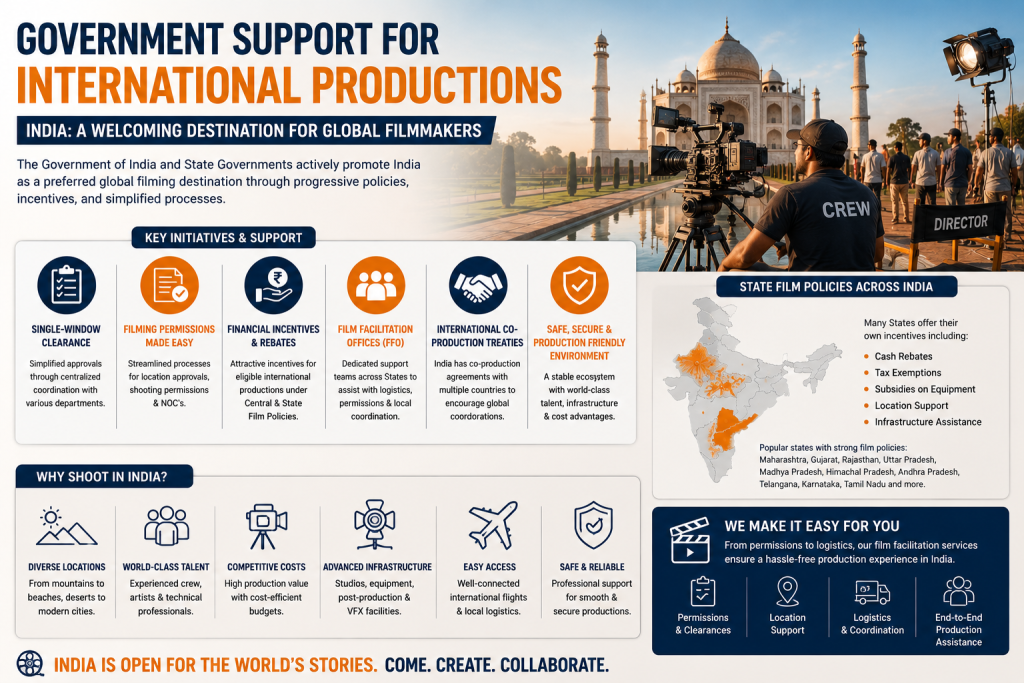
Government Support for International Productions

The Government of India has actively promoted the country as a global filming destination.

Several initiatives have been introduced to simplify filming approvals and encourage international productions. These include film facilitation mechanisms, co-production agreements, and financial incentives for eligible foreign productions.

Many state governments have also introduced their own film policies and incentive programs to attract domestic and international projects.

As a result, India is becoming increasingly competitive with other major global production destinations.


Why International Productions Partner with Filming Indo

While India offers exceptional opportunities for filmmakers, broadcasters, streaming platforms, and content creators, executing a successful production often requires local expertise and reliable on-ground support.

Navigating filming permits, visas, location approvals, government clearances, logistics, equipment sourcing, and multi-city coordination can be complex, particularly for first-time productions in India.

Filming Indo helps international productions manage these challenges efficiently.

Founded in 2015, Filming Indo provides production services across India for documentaries, television programs, feature films, commercials, corporate productions, news coverage, and digital content projects. Our team has supported broadcasters, production companies, journalists, and streaming platforms from Europe, North America, Australia, the Middle East, and Asia.

Our services include filming permits, journalist visa assistance, location scouting, fixer services, line production, crew sourcing, equipment rental coordination, research support, interview arrangements, logistics management, and production planning.

Whether you are planning a documentary in Ladakh, a commercial in Mumbai, a corporate film in Bengaluru, or a multi-city television production across India, Filming Indo provides the local knowledge and production expertise required to deliver projects efficiently and professionally.


Final Thoughts

India’s media and creative industry is entering a period of unprecedented growth. The combination of diverse filming locations, world-class production talent, expanding digital audiences, advanced post-production capabilities, and strong demand for content has positioned India as one of the most attractive creative markets in the world.

For international production companies, broadcasters, OTT platforms, advertising agencies, and creative businesses, India offers opportunities that extend far beyond cost savings. It provides access to a vibrant creative ecosystem capable of supporting everything from large-scale international productions to specialized content projects.

As global demand for content continues to grow, India is expected to play an increasingly important role in the future of media, entertainment, and creative production worldwide.

India Infrastructure & Construction Market Outlook 2026: Opportunities for Global Investors and Businesses

India is currently undertaking one of the most ambitious infrastructure development programs in the world. As the country moves toward its vision of becoming a developed economy by 2047, infrastructure investment has become the cornerstone of economic policy, industrial growth, urban development, and global competitiveness.

From expressways and high-speed rail corridors to smart cities, industrial parks, logistics hubs, airports, ports, renewable energy projects, and digital infrastructure, India is investing at an unprecedented scale. These investments are not only transforming domestic connectivity but also creating significant opportunities for international investors, construction companies, engineering consultants, technology providers, equipment manufacturers, and infrastructure developers.

With sustained government spending, increasing private-sector participation, and a growing focus on integrated infrastructure planning, India has emerged as one of the world’s most attractive infrastructure markets.

This report examines the outlook for India’s infrastructure and construction sector in 2026, key growth drivers, major investment opportunities, and what global businesses should know before entering the market.
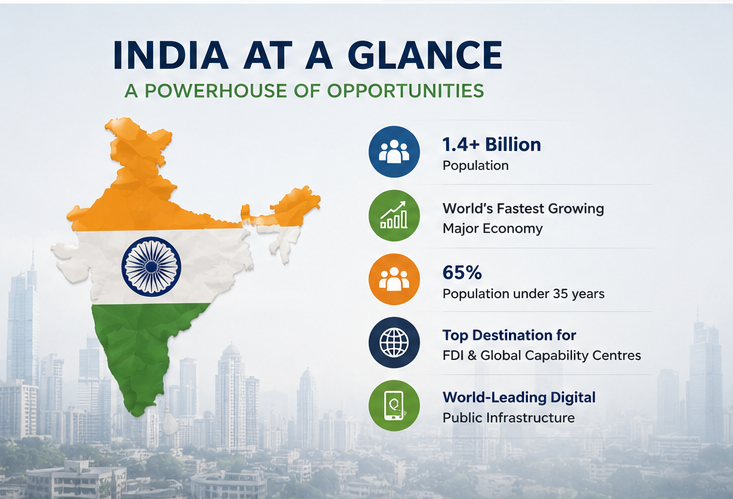

Why India Infrastructure Opportunities Are Attracting Global Investors

Infrastructure development has become central to India’s long-term economic strategy.

Over the last five years, the Government of India has significantly increased capital expenditure, with annual public infrastructure spending reaching historic levels. Major programs such as PM Gati Shakti, Bharatmala, Sagarmala, Smart Cities Mission, Industrial Corridor Development, National Logistics Policy, and Renewable Energy Expansion are creating a multi-trillion-dollar pipeline of projects across the country.

India’s infrastructure ambitions are driven by several structural factors:

  • Rapid urbanization
  • Rising industrial production
  • Growing domestic consumption
  • Expanding export capacity
  • Manufacturing sector growth
  • Increasing foreign direct investment
  • Digital transformation

For international companies, this means access to one of the largest and fastest-growing infrastructure ecosystems globally.


India Construction Market Growth: Key Trends Shaping 2026

The construction market in India continues to be one of the country’s largest economic sectors, contributing significantly to GDP and employment generation.

The sector is expected to maintain strong growth through 2026, supported by government infrastructure spending, urban redevelopment projects, industrial expansion, and private-sector investment.

Several trends are shaping the market:

Shift from Basic Infrastructure to Economic Infrastructure

India’s focus is no longer limited to roads and bridges. The current phase emphasizes economic infrastructure that improves productivity and competitiveness, including logistics parks, industrial corridors, multimodal transport systems, data centers, and integrated manufacturing zones.

Growing Demand for Sustainable Construction

Environmental sustainability is becoming increasingly important. Demand for green buildings, energy-efficient infrastructure, renewable energy integration, and sustainable construction materials continues to rise.

Increasing Technology Adoption

Digital project management, Building Information Modeling (BIM), construction automation, drones, artificial intelligence, and smart monitoring systems are becoming increasingly common across major infrastructure projects.

Infrastructure Investment in India: Government Spending and Policy Support

The Indian government continues to prioritize infrastructure as a catalyst for economic growth.

Major policy initiatives supporting infrastructure investment include:

PM Gati Shakti National Master Plan

PM Gati Shakti aims to integrate infrastructure planning across ministries and states through a unified digital platform. The initiative focuses on reducing logistics costs, improving connectivity, and accelerating project execution.

National Infrastructure Pipeline (NIP)

The National Infrastructure Pipeline represents one of the largest infrastructure investment programs globally, covering transportation, energy, urban development, logistics, and social infrastructure.

National Monetisation Pipeline

The National Monetisation Pipeline seeks to unlock capital through the monetization of existing public assets, encouraging greater private-sector participation in infrastructure development.

Together, these programs are creating significant opportunities for both domestic and international businesses.


Transportation Infrastructure Opportunities in India: Roads, Highways and Expressways

Road infrastructure remains the largest component of India’s infrastructure investment strategy.

The government continues to expand the national highway network through projects designed to improve connectivity between major economic centers, manufacturing hubs, logistics zones, and ports.

Major opportunities exist in:

  • Highway engineering
  • Bridge construction
  • Tunnel development
  • Road safety technologies
  • Intelligent transportation systems
  • Toll management solutions
  • Construction equipment supply

The continued expansion of expressways and economic corridors is expected to generate substantial demand for engineering expertise and construction services throughout the decade.


Railway Infrastructure Projects in India: Opportunities for Global Companies

Indian Railways is undergoing a major modernization program aimed at improving efficiency, freight movement, passenger experience, and network capacity.

Investment opportunities exist across:

  • Dedicated freight corridors
  • High-speed rail systems
  • Metro rail projects
  • Railway station redevelopment
  • Signaling systems
  • Electrification projects
  • Rolling stock manufacturing

As India seeks to reduce logistics costs and improve freight efficiency, railway infrastructure is expected to remain a priority sector.


Ports, Logistics and Supply Chain Infrastructure Opportunities in India

Efficient logistics infrastructure is essential to India’s ambition of becoming a global manufacturing and export hub.

Significant investments are being made in:

  • Port modernization
  • Container terminals
  • Inland waterways
  • Logistics parks
  • Warehousing facilities
  • Cold chain infrastructure
  • Multimodal transport systems

The integration of ports with industrial corridors and manufacturing clusters is creating attractive opportunities for logistics operators, infrastructure investors, and technology providers.


Airport Infrastructure Development in India: A Fast-Growing Investment Sector

India is among the fastest-growing aviation markets in the world.

Rising passenger traffic, tourism growth, and expanding regional connectivity are driving investment in:

  • Greenfield airports
  • Airport expansion projects
  • Cargo terminals
  • Aviation logistics facilities
  • Airport technology solutions

Private participation is playing an increasingly important role in airport development and operation.


Smart Cities and Urban Infrastructure Projects in India

Urbanization remains one of the strongest drivers of infrastructure investment in India.

By 2030, hundreds of millions of Indians are expected to live in urban areas, creating substantial demand for:

  • Urban transport systems
  • Water treatment infrastructure
  • Waste management facilities
  • Affordable housing
  • Smart utility networks
  • Public infrastructure

Tier-2 and Tier-3 cities are emerging as major growth markets for infrastructure developers and technology providers.


Digital Infrastructure and Data Center Construction Opportunities in India

India’s digital economy is expanding rapidly.

The growth of cloud computing, artificial intelligence, digital payments, e-commerce, and government digitization initiatives is driving demand for digital infrastructure.

Key opportunities include:

  • Data center development
  • Telecom infrastructure
  • Fiber networks
  • Power systems
  • Cooling technologies
  • Smart infrastructure solutions

Digital infrastructure is expected to become one of India’s fastest-growing infrastructure segments over the coming decade.


Renewable Energy Infrastructure Opportunities in India

India has established ambitious renewable energy and sustainability targets, creating large-scale investment opportunities.

Key sectors include:

  • Solar power
  • Wind energy
  • Green hydrogen
  • Battery storage
  • Transmission infrastructure
  • Smart grid technologies

The transition toward clean energy is expected to attract significant domestic and foreign investment throughout the coming years.


Industrial Corridors and Manufacturing Infrastructure in India

India’s industrial development strategy is closely linked to infrastructure expansion.

Large-scale industrial corridors are being developed to improve manufacturing competitiveness, attract investment, and strengthen export capacity.

Opportunities exist in:

  • Industrial parks
  • Manufacturing zones
  • Logistics hubs
  • Warehousing facilities
  • Utility infrastructure
  • Factory development

For international manufacturers, these projects provide access to integrated industrial ecosystems with improved connectivity and logistics support.


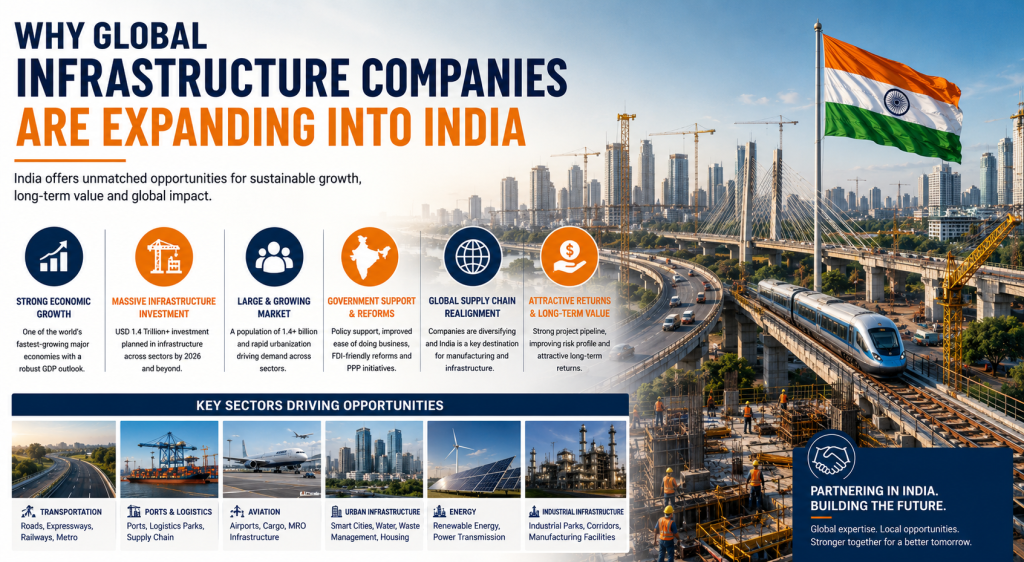
Why Global Infrastructure Companies Are Expanding into India

India offers a combination of scale, growth potential, policy support, and investment opportunities that few markets can match.

International companies are increasingly entering India through:

  • Joint ventures
  • Technology partnerships
  • EPC contracts
  • Equipment supply agreements
  • Infrastructure investment platforms
  • Public-private partnerships

As infrastructure development accelerates, the demand for international expertise, advanced technologies, and innovative financing solutions is expected to increase significantly.

How India Market Entry Helps International Infrastructure Companies Enter India

Successfully navigating India’s infrastructure ecosystem requires local knowledge, market intelligence, stakeholder engagement, and strategic partnerships.

At India Market Entry, we assist international infrastructure companies in identifying opportunities, evaluating market potential, connecting with key stakeholders, and developing effective market-entry strategies.

Our services include:

  • Infrastructure market research
  • Opportunity identification
  • Partner and distributor search
  • Business matchmaking
  • Government engagement support
  • Investment facilitation
  • Trade delegation support
  • Market-entry advisory

Whether you are an infrastructure developer, engineering consultant, technology provider, construction company, or investor, our team helps you establish a strong presence in one of the world’s most dynamic infrastructure markets.


Future Outlook for India’s Infrastructure and Construction Market Beyond 2026

India’s infrastructure transformation is expected to continue well beyond 2026.

Strong government commitment, increasing private participation, rapid urbanization, manufacturing growth, and digital transformation will continue to drive investment across transportation, logistics, energy, urban development, and industrial infrastructure.

For global businesses seeking long-term growth opportunities, India represents not only one of the world’s largest infrastructure markets but also one of the most strategically important.

Companies that establish partnerships, market presence, and project pipelines today will be best positioned to benefit from India’s next phase of economic and infrastructure growth.

Manufacturing & Sourcing Opportunities in India: What Global Buyers Need to Know

As global supply chains continue to evolve, international companies are increasingly looking beyond traditional manufacturing destinations to reduce risk, improve resilience, and access new growth opportunities. In this changing landscape, India has emerged as one of the world’s most attractive manufacturing and sourcing destinations.

The combination of a large industrial base, competitive production costs, skilled workforce, supportive government policies, and a rapidly expanding export ecosystem has positioned India as a strategic sourcing hub for companies across North America, Europe, Australia, the Middle East, Africa, and Asia.

For global buyers, however, sourcing from India is not simply about finding the lowest-cost supplier. Success requires understanding India’s manufacturing strengths, regional industrial clusters, supplier ecosystem, compliance requirements, and quality management practices.

This guide explores why sourcing from India has become a strategic priority for global businesses and how buyers can successfully navigate the Indian manufacturing landscape.

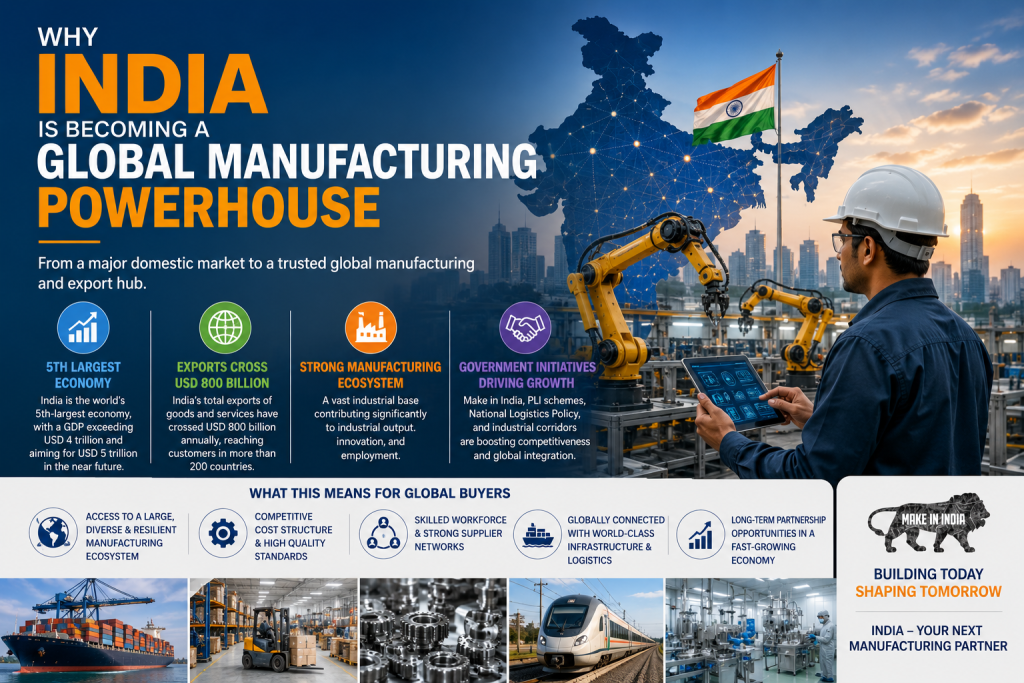
Why India Is Becoming a Global Manufacturing Powerhouse

Over the last decade, India has transformed from primarily a domestic consumption market into a major global manufacturing and export center.

Today, India is the world’s fifth-largest economy, with a GDP exceeding USD 4 trillion and ambitions to become a USD 5 trillion economy within the next few years. The country’s manufacturing sector contributes significantly to industrial output and employment while serving customers in more than 200 countries.

India’s total exports of goods and services have crossed USD 800 billion annually, reflecting the country’s growing integration with global supply chains. Government initiatives such as Make in India, Production Linked Incentive (PLI) schemes, National Logistics Policy, and industrial corridor development programs are further accelerating industrial growth and export competitiveness.

For international buyers, this means access to a manufacturing ecosystem that is larger, more sophisticated, and more globally connected than ever before.


The Global Shift Toward Supply Chain Diversification

The COVID-19 pandemic, geopolitical tensions, shipping disruptions, and rising production costs in several traditional manufacturing locations have fundamentally changed how companies approach sourcing.

Many multinational companies are now implementing what is commonly referred to as a “China Plus One” strategy, seeking additional manufacturing bases to reduce concentration risk and improve supply chain resilience.

India has become one of the primary beneficiaries of this shift.

Unlike many emerging manufacturing markets, India offers a rare combination of scale, engineering talent, domestic demand, and export capabilities. Global companies can source products, establish contract manufacturing operations, and even build long-term production facilities while serving both domestic and international markets.

This dual advantage has made India particularly attractive for companies seeking sustainable long-term sourcing partnerships rather than purely transactional supplier relationships.


Key Manufacturing Sectors Driving India’s Export Growth

One of India’s greatest strengths is the diversity of its manufacturing capabilities. Rather than relying on a single industry, the country has developed strong expertise across multiple sectors.

Engineering and Industrial Products

Engineering goods represent one of India’s largest export sectors and are widely sourced by international buyers.

Indian manufacturers supply industrial machinery, pumps, valves, castings, forgings, fabricated metal products, electrical equipment, precision components, industrial tools, and specialized engineering solutions to global markets.

Many suppliers operate according to international quality standards such as ISO, CE, ASME, API, and customer-specific certification requirements.

The engineering sector is particularly attractive for buyers seeking custom manufacturing, low-to-medium volume production, and complex fabrication capabilities.

Automotive Components and Precision Manufacturing

India has established itself as a major automotive manufacturing hub and is home to thousands of component manufacturers serving leading global vehicle brands.

The sector has developed strong expertise in precision machining, forging, casting, injection molding, sheet metal fabrication, and assembly operations.

International buyers source a wide range of products including engine components, transmission systems, suspension parts, electrical systems, and aftermarket products from India.

The industry’s mature supplier ecosystem allows buyers to source both individual components and complete assemblies.


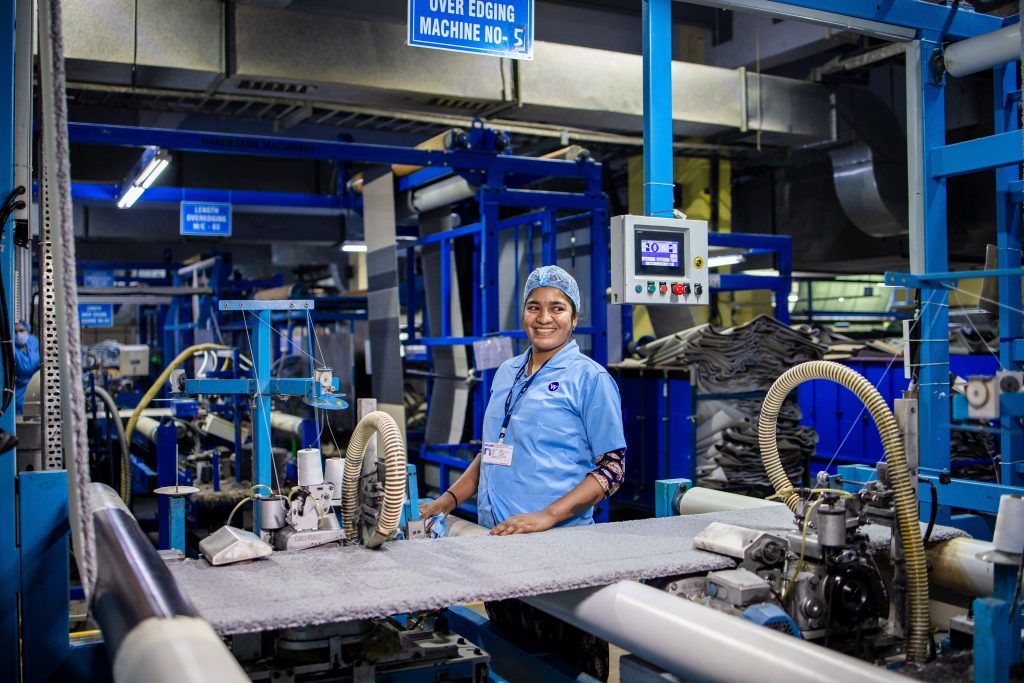
Textiles, Apparel, and Home Furnishings

India remains one of the world’s largest producers of cotton, textiles, and apparel products.

The country offers sourcing opportunities across the entire textile value chain, from raw materials and yarn to finished garments and home furnishing products.

Global buyers regularly source:

  • Apparel and fashion products
  • Home textiles
  • Towels and bath products
  • Bed linen
  • Decorative furnishings
  • Technical textiles

Indian textile manufacturers increasingly focus on sustainability, traceability, and compliance with international environmental standards, making them attractive partners for global brands.


Pharmaceuticals and Healthcare Products

India has earned international recognition as the “Pharmacy of the World” due to its large-scale production of generic medicines and pharmaceutical ingredients.

The country supplies approximately one-fifth of the world’s generic medicine requirements and maintains one of the largest numbers of pharmaceutical manufacturing facilities approved by international regulatory authorities outside the United States.

Beyond pharmaceuticals, India also offers sourcing opportunities in medical devices, healthcare consumables, nutraceuticals, and wellness products.


Building Materials and Construction Products

Rapid infrastructure development and urbanization have helped create a highly competitive building materials sector.

International buyers source a wide range of products from India including ceramic tiles, sanitaryware, natural stone, engineered stone surfaces, construction hardware, steel products, architectural fittings, and interior furnishing materials.

Industrial clusters such as Morbi in Gujarat have become globally recognized sourcing destinations for ceramic products and sanitaryware.

Electronics and Electrical Equipment

India’s electronics manufacturing sector has expanded rapidly over the last decade.

Government incentive programs have encouraged investments in mobile phones, consumer electronics, industrial electronics, electrical equipment, and component manufacturing.

As global electronics supply chains continue to diversify, India is expected to play an increasingly important role in serving international markets.


Understanding India’s Manufacturing Clusters

One of the most important aspects of successful sourcing from India is understanding regional industrial specialization.

Unlike smaller countries where industries may be concentrated in one location, India’s manufacturing ecosystem is spread across multiple specialized industrial clusters.

Gujarat has developed strong capabilities in chemicals, pharmaceuticals, ceramics, engineering products, and industrial manufacturing. Maharashtra serves as a hub for automotive, engineering, chemicals, and industrial equipment production. Tamil Nadu is widely known for automobiles, textiles, electronics, and precision manufacturing. Karnataka has emerged as a center for aerospace, engineering, and advanced technology manufacturing.

Punjab is renowned for hand tools, sports goods, and engineering products, while Rajasthan is recognized for natural stone, handicrafts, and textiles. Uttar Pradesh offers strong capabilities in leather products, engineering goods, food processing, and consumer products.

Identifying the right manufacturing cluster often leads to better supplier options, lower costs, improved logistics, and stronger long-term sourcing relationships.


Challenges Global Buyers Should Be Prepared For

While India offers significant sourcing advantages, foreign buyers should approach the market strategically.

One of the most common mistakes made by first-time buyers is selecting suppliers solely on the basis of pricing. Manufacturing capabilities, export experience, quality systems, financial stability, and production capacity can vary significantly among suppliers.

Supplier verification is therefore essential.

Buyers should conduct factory audits, assess production capabilities, review export records, verify certifications, and evaluate management systems before entering into commercial agreements.

Quality management is another critical area. Successful sourcing programs typically include pre-production inspections, in-process quality checks, and final shipment inspections to ensure consistency and compliance with specifications.

Communication and project management also play an important role. Clear technical documentation, detailed product specifications, approved samples, and structured communication processes help prevent misunderstandings and reduce sourcing risks.


Contract Manufacturing Opportunities in India

Many international companies are moving beyond traditional sourcing models and establishing contract manufacturing partnerships in India.

Under this approach, Indian manufacturers produce goods according to the buyer’s specifications, branding requirements, and quality standards.

Contract manufacturing can offer several advantages including lower capital investment, faster market entry, improved scalability, and access to specialized manufacturing expertise.

Industries such as engineering products, consumer goods, healthcare products, electronics, building materials, and industrial equipment have seen substantial growth in contract manufacturing arrangements.

For companies seeking a long-term presence in India, contract manufacturing often serves as a stepping stone toward broader supply chain integration and market expansion.

manufacturing-sourcing-opportunities-india-global-buyers5-1024x683.png

The Importance of Local Market Knowledge

Despite its enormous potential, India remains a complex and highly diverse market.

Supplier identification, due diligence, factory verification, compliance management, negotiations, logistics coordination, and quality assurance require local knowledge and on-ground expertise.

Many international buyers discover that working with a local sourcing and market-entry partner significantly reduces risk while accelerating supplier identification and onboarding.

Professional support can help buyers avoid costly mistakes, improve supplier selection, shorten procurement timelines, and establish more reliable sourcing operations.


How India Market Entry Supports Global Buyers

At India Market Entry, we help international companies identify, evaluate, and engage with reliable manufacturing partners across India.

Our team works closely with foreign businesses seeking to source products, establish contract manufacturing arrangements, diversify supply chains, or explore investment opportunities in India’s manufacturing sector.

Our services include supplier identification, factory audits, supplier verification, market research, business matchmaking, sourcing support, production monitoring, quality inspections, and trade delegation assistance.

Leveraging an extensive network of manufacturers, exporters, industry associations, chambers of commerce, and regional partners across India, we help global buyers navigate the complexities of the Indian market with confidence.

Whether you are sourcing industrial products, building materials, consumer goods, textiles, engineering components, or specialized manufacturing solutions, our objective is to help you identify reliable suppliers, reduce sourcing risks, and build sustainable long-term business relationships.


Conclusion

India’s rise as a global manufacturing and sourcing destination is no longer a future opportunity—it is a present reality. The country’s vast industrial ecosystem, competitive production capabilities, skilled workforce, and supportive policy environment make it one of the most attractive sourcing destinations for international businesses seeking resilient and diversified supply chains.

However, successful sourcing from India requires more than simply finding a supplier. It demands careful market research, supplier due diligence, quality management, and local expertise.

For companies looking to capitalize on India’s manufacturing strengths, the right local partner can make the difference between a successful sourcing program and a costly learning experience. With the right strategy and support, India offers global buyers access to one of the world’s most dynamic and rapidly expanding manufacturing ecosystems.

Need Help Sourcing from India?

Our team assists foreign companies with supplier search, factory audits, quality inspections, business matchmaking, and contract manufacturing partnerships across India. Get in touch to discuss your sourcing requirements and identify reliable Indian suppliers.

Finding Reliable Business Partners in India: A Practical Guide for Foreign Companies

India has become one of the world’s most attractive destinations for international businesses seeking growth, manufacturing diversification, sourcing opportunities, and access to a rapidly expanding consumer market. As the world’s fifth-largest economy, India recorded a GDP exceeding USD 4 trillion and continues to rank among the fastest-growing major economies globally.

For foreign companies looking to enter India, finding reliable business partners is often the single most important factor determining market success. Whether the objective is to appoint distributors in India, identify qualified suppliers, establish a sourcing office, or develop a strategic joint venture, selecting the right local partner can significantly reduce market entry risks and accelerate growth.

However, India’s vast geography, diverse business environment, and fragmented distribution networks make partner identification more complex than in many developed markets. This guide provides a structured approach for foreign companies seeking trusted business partners in India.


Why Finding the Right Business Partners in India Matters

India’s market potential is substantial. With a population exceeding 1.4 billion people and a rapidly growing middle class, the country offers significant opportunities across manufacturing, technology, healthcare, infrastructure, renewable energy, consumer products, food processing, and industrial equipment.

India’s merchandise exports have crossed USD 430 billion annually, while services exports have exceeded USD 380 billion, demonstrating the country’s growing integration into global supply chains.

Despite these opportunities, foreign companies often face challenges including:

  • Limited visibility of reliable local companies
  • Regional differences in business practices
  • Complex distribution channels
  • Supplier verification concerns
  • Regulatory and compliance requirements
  • Cultural and communication gaps

An experienced and trustworthy local partner can help navigate these challenges effectively.


Understanding the Different Types of Business Partners in India

Before beginning a partner search, foreign companies should clearly identify the type of partnership required.

Distributors in India

Distributors purchase products and resell them through established networks.

This model is particularly common in:

  • Industrial machinery
  • Medical equipment
  • Consumer goods
  • Chemicals
  • Building materials
  • Electronics

Appointing the right distributor can provide immediate access to customers without the need to establish a local office.

Suppliers and Contract Manufacturers

India has emerged as a major global sourcing destination under the China+1 strategy.

Key sourcing sectors include:

  • Engineering products
  • Automotive components
  • Textiles and garments
  • Pharmaceuticals
  • Chemicals
  • Packaging materials
  • Renewable energy components
  • Electronics manufacturing

A professional supplier search in India can help foreign companies identify qualified manufacturers that meet international quality standards.

Joint Venture Partners

Joint ventures remain popular in sectors requiring local expertise, manufacturing facilities, technology transfer, or large-scale investments.

Potential benefits include:

  • Faster market entry
  • Shared investment risk
  • Local market knowledge
  • Regulatory support
  • Established customer relationships

Sales Representatives and Agents

Companies entering India for the first time often appoint local representatives to test market demand before making larger investments.

This model allows businesses to evaluate opportunities with relatively low financial commitment.


India’s Regional Markets Require Different Partnership Strategies

One of the most common mistakes foreign companies make is viewing India as a single market.

In reality, India consists of multiple regional markets with distinct consumer preferences, languages, and distribution structures.

business-partners-distributors-suppliers-india1

Northern India

Major business hubs include:

  • Delhi NCR
  • Chandigarh
  • Jaipur
  • Lucknow

Strong sectors:

  • Infrastructure
  • Construction
  • Government procurement
  • Consumer goods

Western India

Key commercial centers:

  • Mumbai
  • Pune
  • Ahmedabad
  • Surat

Strong sectors:

  • Financial services
  • Manufacturing
  • Chemicals
  • Pharmaceuticals
  • Engineering

Southern India

Major hubs:

  • Bengaluru
  • Chennai
  • Hyderabad
  • Kochi

Strong sectors:

  • Technology
  • Electronics
  • Aerospace
  • Automotive
  • Healthcare

Eastern India

Key cities:

  • Kolkata
  • Bhubaneswar
  • Guwahati

Strong sectors:

  • Mining
  • Logistics
  • Infrastructure
  • Agriculture

Understanding regional strengths helps foreign companies identify partners with the appropriate geographic reach and industry expertise.


How to Find Reliable Distributors in India

business-partners-distributors-suppliers-india2

Participate in Industry Trade Shows

India hosts hundreds of international trade exhibitions every year across sectors including manufacturing, healthcare, construction, food processing, textiles, electronics, and renewable energy.

Trade shows provide opportunities to:

  • Meet distributors face-to-face
  • Evaluate competitors
  • Understand market demand
  • Build direct relationships

Face-to-face interaction remains one of the most effective methods of identifying serious business partners.

Engage Business Matchmaking Services

Professional business matchmaking services help foreign companies:

  • Identify potential distributors
  • Screen suppliers
  • Arrange B2B meetings
  • Verify credentials
  • Conduct market assessments

This significantly reduces the time and resources required to identify suitable partners.

Work with Industry Associations

Industry associations often maintain extensive member databases and can assist with partner identification.

These organizations can provide valuable insights into market reputation and industry standing.


Supplier Search India: Conducting Effective Due Diligence

Identifying potential suppliers is only the first step. Comprehensive verification is essential before entering into commercial agreements.

Verify Legal Registration

Confirm:

  • Company incorporation status
  • Ownership structure
  • GST registration
  • Export licenses where applicable

Assess Financial Stability

Review:

  • Financial statements
  • Banking relationships
  • Credit reports
  • Trade references

Financially stable suppliers are better positioned to support long-term business relationships.

Evaluate Production Capacity

Verify:

  • Manufacturing capabilities
  • Production capacity
  • Technology standards
  • Workforce strength
  • Quality management systems

Factory visits are strongly recommended before finalizing supplier agreements.

Review International Certifications

Many export-oriented Indian manufacturers hold certifications such as:

  • ISO 9001
  • ISO 14001
  • CE Certification
  • FDA Compliance
  • GMP Certification
  • IATF Automotive Standards

These certifications provide additional confidence regarding quality and compliance standards.


Red Flags Foreign Companies Should Watch For

While India offers numerous credible business opportunities, caution is essential when evaluating potential partners.

Warning signs may include:

  • Unrealistic sales projections
  • Reluctance to share references
  • Lack of physical infrastructure
  • Requests for immediate exclusivity
  • Poor communication standards
  • Frequent management changes
  • Limited industry experience

Proper due diligence helps avoid costly mistakes and partnership failures.


Why Business Matchmaking Services Improve Success Rates

Many foreign companies underestimate the complexity of finding suitable business partners in India.

Professional matchmaking services can provide:

Pre-Qualified Partner Identification

Potential partners are screened based on:

  • Industry experience
  • Financial capability
  • Market presence
  • Technical expertise

Business Verification

Verification typically includes:

  • Company background checks
  • Market reputation assessment
  • Operational reviews
  • Reference checks

B2B Meeting Coordination

Qualified meetings save significant time and ensure discussions take place with decision-makers rather than intermediaries.

Ongoing Market Support

Support may include:

  • Market intelligence
  • Partner negotiations
  • Follow-up coordination
  • Market expansion strategies

Building Long-Term Business Relationships in India

Business success in India often depends on relationship-building rather than transactional interactions alone.

Foreign companies that achieve long-term success typically:

  • Visit India regularly
  • Maintain direct communication
  • Invest in partner training
  • Provide marketing support
  • Establish realistic growth targets
  • Build trust over time

Strong relationships frequently evolve into strategic partnerships that support expansion across multiple regions and sectors.


Business Partner Selection Checklist for Foreign Companies

Before appointing a distributor, supplier, or strategic partner in India, ensure that the company has:

✔ Verified legal registration

✔ Strong financial standing

✔ Relevant industry experience

✔ Established customer references

✔ Adequate infrastructure and resources

✔ Transparent communication practices

✔ Proven market reputation

✔ Clear growth strategy

✔ Ability to support long-term business objectives


India’s growing economy, expanding manufacturing base, and increasing integration into global supply chains make it one of the most attractive destinations for international business expansion.

However, market success often depends on identifying reliable business partners in India who possess the expertise, infrastructure, financial capability, and market reach required to support long-term growth.

Whether seeking distributors in India, conducting a supplier search, establishing sourcing operations, or exploring strategic alliances, a structured approach that combines market research, due diligence, and professional business matchmaking can significantly improve outcomes and reduce market entry risks.

For foreign companies planning expansion into India, investing time and resources in partner identification is not merely a preliminary step—it is a critical strategic decision that can determine long-term success in one of the world’s most dynamic markets.

Why India? A Strategic Market Entry Guide for International Companies in 2026

Introduction: Why Global Companies Are Looking at India

As multinational corporations reassess their global expansion strategies, India has emerged as one of the most attractive destinations for investment, manufacturing, sourcing, and business growth. With a population exceeding 1.4 billion people, a GDP of more than US$4 trillion, and a rapidly growing consumer base, India offers international businesses a unique combination of market scale, skilled talent, and economic resilience.

Whether you are a technology company, manufacturer, retailer, service provider, or investor, entering the India market presents significant opportunities for long-term growth and profitability.

India Market Entry: A Growing Economic Powerhouse

India continues to be one of the world’s fastest-growing major economies. Strong domestic consumption, infrastructure investments, manufacturing expansion, and digital transformation have positioned the country as a preferred destination for foreign businesses.

Foreign Direct Investment (FDI) inflows reached approximately US$81 billion in FY 2024-25, while cumulative FDI inflows since 2000 have crossed US$1.14 trillion. These figures demonstrate growing confidence among international investors and global corporations in India’s long-term economic prospects.

For companies considering India market entry, the country’s stable economic outlook and large domestic market provide a strong foundation for expansion.

Why Doing Business in India Makes Strategic Sense

Access to One of the World’s Largest Consumer Markets

India is home to one of the largest and youngest consumer markets globally. Rising incomes, urbanisation, and growing digital connectivity are driving demand across multiple sectors, including consumer goods, healthcare, education, financial services, retail, travel, and technology.

By 2030, India is expected to become one of the world’s leading consumption-driven economies, creating significant opportunities for international brands seeking new customers and revenue streams.

Strategic Location for Global Business

India’s geographical position provides access to key international markets across Asia, the Middle East, Africa, and Europe. Many multinational companies use India as a regional hub for operations, sourcing, manufacturing, and exports.

This strategic location allows businesses to efficiently serve both domestic and international markets from a single base.

Entering India Market Through Manufacturing and Supply Chain Expansion

Global supply chains are undergoing a major transformation, with many companies adopting a “China Plus One” strategy to diversify manufacturing operations.

India has emerged as a leading beneficiary of this shift. Through initiatives such as Make in India and Production Linked Incentive (PLI) schemes, the Government of India has encouraged investments in sectors such as:

  • Electronics Manufacturing
  • Semiconductors
  • Automotive and EVs
  • Renewable Energy
  • Pharmaceuticals
  • Medical Devices
  • Telecom Equipment

More than 836 manufacturing projects have been approved under various PLI schemes, attracting investments exceeding US$25 billion and generating manufacturing output valued at over US$235 billion.

For foreign manufacturers, India offers a combination of competitive costs, skilled labour, government incentives, and access to a large domestic market.

India’s Skilled Workforce: A Key Advantage for International Companies

One of India’s greatest strengths is its vast talent pool. Every year, the country produces millions of graduates in engineering, information technology, finance, management, healthcare, and scientific research.

This has led many global corporations to establish:

  • Global Capability Centres (GCCs)
  • Research & Development Facilities
  • Shared Service Centres
  • Technology Development Hubs

Cities such as Bengaluru, Hyderabad, Pune, Chennai, Mumbai, and Delhi NCR have become globally recognised innovation centres, attracting investments from leading multinational companies.

Digital India: Transforming the Business Environment

India’s digital revolution has fundamentally changed the way businesses operate.

The country has built one of the world’s most advanced digital public infrastructures through initiatives such as:

  • Aadhaar Digital Identity
  • Unified Payments Interface (UPI)
  • DigiLocker
  • Digital India Programme

UPI alone processes billions of transactions every month, making India the world’s largest real-time digital payments market.

For international businesses, this digital ecosystem simplifies customer onboarding, payments, compliance, and business operations, enabling faster market penetration and scalability.

Setting Up Business in India: Popular Market Entry Options

Foreign companies have several options when entering India:

Wholly Owned Subsidiary

The most common structure for long-term investments, providing complete ownership and operational control.

Joint Venture

Suitable for companies seeking local expertise, established distribution networks, and market knowledge.

Liaison Office

Ideal for market research, relationship building, and exploring opportunities before making substantial investments.

Branch Office

Allows foreign companies to undertake approved business activities in India while maintaining direct control.

Distribution and Strategic Partnerships

A cost-effective approach for companies testing market potential before establishing a physical presence.

Challenges of Doing Business in India

While India offers significant opportunities, successful market entry requires careful planning.

Common challenges include:

  • Regulatory compliance requirements
  • Diverse regional markets
  • Complex distribution networks
  • Localisation of products and services
  • Talent acquisition and retention

Companies that invest in market research, compliance planning, and local partnerships generally achieve better long-term results.

why-india-market-entry-guide-for-international-companies

Foreign Investment in India: Sectors with High Growth Potential

Several sectors are attracting significant international investment:

Technology and Artificial Intelligence

India’s growing digital economy continues to create opportunities in software, AI, cloud computing, cybersecurity, and fintech.

Renewable Energy

Government targets for clean energy are driving investments in solar, wind, battery storage, and green hydrogen projects.

Healthcare and Pharmaceuticals

India remains one of the world’s leading pharmaceutical manufacturing hubs and a rapidly expanding healthcare market.

Infrastructure and Construction

Major investments in highways, railways, airports, logistics parks, and smart cities continue to generate opportunities for foreign investors.

Electronics and Semiconductor Manufacturing

Government incentives and growing domestic demand are positioning India as a global electronics manufacturing destination.

Conclusion: Why International Companies Should Enter India Now

India’s combination of economic growth, market size, skilled workforce, digital infrastructure, and investor-friendly reforms makes it one of the most attractive destinations for international expansion.

For businesses evaluating India market entry opportunities, the country offers far more than a large consumer market. It provides a strategic platform for manufacturing, innovation, sourcing, technology development, and regional expansion.

Companies that establish a strong presence today will be well-positioned to benefit from India’s continued transformation into one of the world’s leading economic powers over the coming decades.